


Fetish in the 1990s: Latex, Club Culture, Body Modification, Post-Porn, and the Birth of the Digital Underground
The 1990s inherited a fetish culture that had already developed its own magazines, clubs, organizations, fashion codes, artists, public events, and urban territories, but the decade changed the way these worlds connected. After the devastating impact of AIDS on queer communities during the 1980s, sexuality entered the new decade accompanied by grief, activism, safer-sex politics, and a determination to rethink who controlled representations of bodies and desire. At the same time, globalization, electronic music, rave culture, increasingly sophisticated synthetic clothing, body modification, independent publishing, and the early internet created new environments in which fetish identities could circulate.
If the leather cultures of the 1970s had been organized around physical communities and the 1980s had seen fetish aesthetics increasingly appropriated by fashion and art, the 1990s introduced something different: fragmentation. There was no longer one dominant fetish silhouette. Leather existed alongside latex and rubber, hypermasculinity alongside androgyny, BDSM alongside body modification, industrial culture alongside glamour, and established leather codes alongside the deliberately unstable identities of club culture.
The body increasingly appeared as something that could be edited. It could be pierced, tattooed, compressed, covered, inflated, masked, disciplined, photographed, digitized, or transformed into an invented persona, while the arrival of networked communication meant that people interested in highly specific forms of fetishism were beginning to find one another without necessarily entering the same bar, shop, or city. The fetish underground was becoming a network.
Sexuality, Activism, and the Politics of the Body
The AIDS crisis continued throughout the 1990s, and its consequences remained deeply embedded within queer, leather, BDSM, and sexual communities. The loss of enormous numbers of people during the previous decade had transformed nightlife, relationships, community organizations, publishing, and the ways sexual knowledge circulated.
Activism had also changed the visual politics of sexuality. Organizations such as ACT UP demonstrated how graphic design, photography, clothing, public demonstration, and the body itself could become political media, while queer activists increasingly challenged the assumption that respectability was the only route toward social acceptance.

For fetish and BDSM communities, this period reinforced discussions around communication, negotiation, risk, and responsibility. The body could not be separated from questions of health, autonomy, consent, and political visibility, while safer-sex cultures developed sophisticated strategies for discussing pleasure without pretending that risk could simply disappear.
The result was not a retreat from sexuality but a more complex understanding of it. Desire could exist alongside responsibility, while sexual communities increasingly insisted upon the right to produce their own knowledge rather than allowing medicine, government, or mainstream morality to define them exclusively from outside.
Latex and the Synthetic Body
Leather remained fundamental to fetish culture during the 1990s, but latex and rubber became increasingly prominent symbols of a different kind of body. Where leather carried histories of motorcycles, military clothing, labour, masculinity, and physical durability, latex suggested artificiality, transformation, technological surface, and an almost seamless relationship between garment and skin.
Improvements in specialist garment construction allowed increasingly elaborate catsuits, dresses, gloves, stockings, hoods, uniforms, and corseted silhouettes to be produced from rubber and latex. The material could follow the body's contours with extraordinary precision while simultaneously replacing the visual texture of skin with a reflective manufactured surface.
This ambiguity made latex particularly compatible with the cultural imagination of the decade. Cyberpunk, electronic music, computer graphics, biotechnology, virtual reality, science fiction, and anxieties surrounding the relationship between humans and machines were reshaping popular culture. A latex-covered body seemed capable of belonging simultaneously to the fetish club, the laboratory, the fashion editorial, and an imagined technological future.
Rather than simply dressing the body, latex appeared to redesign its surface.
Fetish Fashion Becomes an International Language
The movement of fetish aesthetics into fashion accelerated dramatically during the decade. Corsets, harness structures, thigh-high boots, PVC, latex, leather, straps, masks, body-conscious silhouettes, and references to bondage increasingly appeared in runway collections, magazines, music imagery, and editorial photography.

Designers including Jean Paul Gaultier, Thierry Mugler, and Alexander McQueen approached the body as something that could be dramatically reconstructed through clothing. Their work differed considerably, but each participated in a broader rejection of the idea that fashion needed to preserve a natural silhouette or conventional relationship between masculinity and femininity.
Mugler's sculptural bodies could appear armored, insect-like, mechanical, or superhuman, while Gaultier repeatedly destabilized conventional gender codes through corsetry, underwear, uniforms, and exaggerated archetypes. McQueen, emerging during the decade, pushed fashion toward more psychologically unsettling territories in which restriction, vulnerability, historical references, sexuality, and bodily transformation could coexist.
Fetish culture had explored many of these ideas for decades, particularly the possibility that clothing could construct rather than merely decorate identity. During the 1990s, that principle became one of fashion's most productive sources of experimentation.
Madonna, Sex, and the Mainstreaming of BDSM Imagery
Few mainstream cultural projects demonstrated this transition as explicitly as Madonna's 1992 book Sex and the surrounding Erotica era. Produced with photographer Steven Meisel, Sex incorporated BDSM, leather, voyeurism, queer sexuality, roleplay, dominance, submission, and club imagery into an elaborately
designed commercial publication distributed internationally.

Madonna's 1992 book Sex.
Its importance did not lie in introducing these practices or aesthetics, which already possessed extensive histories, but in placing them inside one of the largest celebrity platforms of the period. Imagery that might previously have circulated through specialist magazines, fetish photography, queer nightlife, or underground cinema suddenly appeared within global popular culture.
The project also demonstrated the complicated consequences of mainstream visibility. Fetish imagery could reach audiences on a scale underground publishers could never have achieved, but the cultures that produced those aesthetics risked being reduced to provocative styling once removed from their social contexts.
This tension between visibility and appropriation would become one of the defining questions surrounding fetish fashion during the following decades.
Club Kids and the Collapse of the Ordinary Body

If fashion transformed the body through professional design, the Club Kids of New York approached identity as an open-ended experiment performed directly within nightlife. Figures associated with the scene constructed elaborate personas using makeup, platforms, masks, prosthetic forms, toys, plastics, medical references, body paint, gender exaggeration, and deliberately absurd silhouettes.
The importance of this culture to fetish history lies in its refusal of a stable body. The club could become an environment where someone entered as one identity and appeared several hours later as an entirely different creature, gender, object, caricature, or visual proposition.
This extended ideas already explored by Leigh Bowery during the 1980s, but the 1990s placed them within a larger nightlife ecosystem shaped by rave culture, electronic music, fashion, drag, performance, and media spectacle. Clothing no longer needed to flatter anatomy because it could distort it, conceal it, enlarge it, or make the human form deliberately difficult to interpret.
Fetish aesthetics increasingly overlapped with this culture of transformation because masks, latex, rubber, corsetry, restrictive garments, uniforms, and extreme footwear offered ready-made technologies for abandoning the everyday body.
Body Modification and the Body as Material
Piercing and tattooing also became increasingly visible within Western alternative culture during the 1990s, while more extreme forms of body modification circulated through specialist communities, publications, conventions, and emerging online networks.
The relationship between body modification and fetish culture was not universal, but the two worlds frequently overlapped through shared interests in transformation, ritual, pain, endurance, identity, and the deliberate rejection of standardized appearance.

The influential magazine Modern Primitives, published in 1989, helped shape conversations that continued strongly into the following decade by bringing tattooing, piercing, scarification, and other bodily practices into contact with alternative cultural audiences. During the 1990s, piercing in particular moved rapidly from subcultural environments toward fashion and mainstream youth culture.
This development altered the relationship between fetish and object. Clothing could always be removed, but modification allowed the body itself to carry signs of chosen identity. Metal, ink, scars, and altered anatomy could become permanent or semi-permanent components of personal appearance. The body was no longer simply the surface upon which fetish fashion operated; increasingly, the body itself could become the designed object.
Catherine Opie and the Community Portrait
The photography of Catherine Opie introduced another crucial perspective on fetish and queer representation during the decade. Her early-1990s portraits of friends and members of queer leather communities in Los Angeles approached subjects with a visual seriousness historically reserved for formal portraiture.
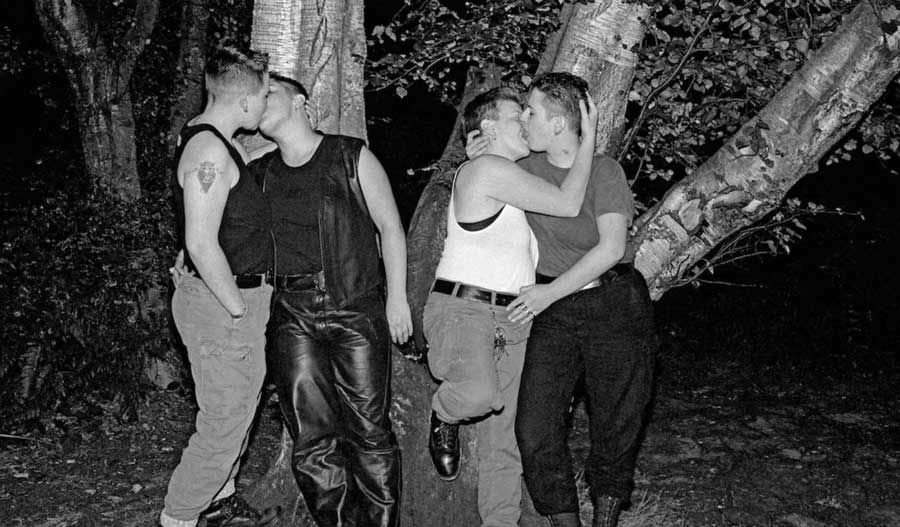
Catherine Opie.
This mattered because fetish communities had frequently been photographed either as erotic spectacle or as evidence of social deviance. Opie's work complicated both traditions by presenting leather identities, body modification, gender nonconformity, and queer relationships as part of a broader social world composed of individuals with names, histories, friendships, and communities.
The fetish body was no longer simply an anonymous object of desire. It could also be a portrait of a person whose clothing, scars, piercings, posture, and chosen identity formed part of a larger biography.
This shift paralleled a broader transformation in queer cultural production during the 1990s, when artists increasingly documented their own communities rather than waiting for mainstream institutions to decide which lives were worthy of representation.
Post-Porn and the Rewriting of Sexual Representation
The 1990s also saw the growing influence of post-porn, sex-positive performance, and forms of erotic cultural production that questioned who controlled sexual imagery and whose desires were allowed to appear within it.
Annie Sprinkle became one of the central figures in this transformation. Through performance, writing, education, photography, and public discussion, she challenged conventional boundaries separating pornography, art, sexual education, feminism, and personal autobiography.

Annie Sprinkle.
The significance of post-porn to fetish culture lay partly in its emphasis on agency. Rather than treating sexual representation as something produced exclusively for an anonymous viewer, performers and artists could consciously construct their own erotic personas, discuss the politics surrounding them, and expose the mechanisms through which sexual imagery was produced.
This opened space for bodies, genders, practices, and identities poorly represented by conventional pornography. Fetish could become not only a subject of representation but a method for examining how representation itself produces ideas about desire. The camera was no longer assumed to be neutral, and neither was the viewer.
Cyberfetish and the Imagined Digital Body
Few cultural changes would ultimately affect fetish communities as profoundly as the arrival of the internet. During the early and mid-1990s, access remained limited compared with the digital environment that would follow, yet bulletin-board systems, Usenet groups, personal websites, chat rooms, mailing lists, and online forums began connecting people around specialized interests with unprecedented speed.

For fetish communities, the implications were enormous. Someone interested in rubber, bondage, boots, uniforms, body modification, dominance and submission, or highly specific fantasies no longer depended entirely upon finding the right magazine, club, advertisement, or local social network.
The architecture of community was beginning to detach itself from geography.
Digital culture also created new forms of identity. Screen names, avatars, text-based roleplay, anonymous communication, and online personas allowed individuals to experiment with gender, authority, submission, appearance, and fantasy without necessarily presenting their everyday identity.
The mask, one of the oldest instruments of transformation, had acquired a digital equivalent.
The Internet Changes the Fetish Archive
The early web also began transforming the way fetish imagery was stored and circulated. Throughout most of the twentieth century, photographs, drawings, magazines, films, catalogues, and correspondence had existed as physical objects that could be difficult to obtain and easy to destroy. Digital files introduced a radically different model based on copying.
An image could now circulate between users without leaving the original collection. Small websites could become informal archives, while online communities could gather photographs and information that previously existed only in geographically isolated collections.
This did not automatically preserve history, because early websites disappeared constantly and digital files could lose their provenance as they were copied. Yet the fundamental relationship between scarcity and access was changing.
Fetish culture had spent much of the century attempting to locate itself through printed matter and physical spaces. By the end of the 1990s, a search box and an internet connection were beginning to replace the catalogue and the envelope.
Underground Clubs That Defined the 1990s
The 1990s underground was international, with clubs functioning as laboratories where electronic music, queer culture, fashion, fetish aesthetics, drag, performance, and new identities could develop long before many of their visual codes reached mainstream culture.
Bunker, Berlin
Operating inside a Second World War air-raid shelter, Bunker became one of post-Wall Berlin's most extreme environments for hardcore techno and underground culture, while also hosting the early SNAX fetish parties that connected the city's electronic and sexual subcultures.

Bunker, Berlin.
Tresor, Berlin
Opened in 1991 in the vaults of the former Wertheim department store, Tresor transformed abandoned concrete architecture into one of the defining spaces of techno and established an industrial club aesthetic that would influence nightlife internationally.
Trade, London
Founded at Turnmills in 1990, Trade was London's pioneering legal after-hours club, bringing gay and straight crowds together around hard house, techno, extreme fashion, and a distinctly queer culture that continued from the middle of the night into Sunday afternoon.

Trade, London.
Duckie, London
Beginning at the Royal Vauxhall Tavern in 1995, Duckie offered an alternative to increasingly commercial gay clubbing by mixing queer performance, eccentric fashion, cabaret, music, and deliberately unconventional identities.
Rex Club, Paris
During the 1990s, Rex became one of the central institutions of French electronic culture, with Laurent Garnier's Wake Up nights connecting Paris directly to Detroit techno, Chicago house, and the emerging European rave network.
Queen, Paris
The Champs-Élysées gay club became one of 1990s Paris's most influential intersections between queer nightlife and electronic music, particularly through its celebrated Respect Is Burning parties, which attracted an increasingly mixed audience and international DJs.
Cox, Paris
These gay nightlife institutions formed part of a much larger Parisian ecosystem whose cultural importance became especially visible in 1997, when thousands protested the authorities' closure of several gay clubs.
Limelight, New York
Located inside a deconsecrated church, Limelight became one of the defining environments of 1990s New York club culture, connecting rave, Club Kids, drag, extravagant fashion, electronic music, and the theatrical transformation of identity.

Limelight, New York.
Tunnel, New York
The enormous former railway terminal became another center of New York's 1990s nightlife, hosting electronic music, queer events, fashion experimentation, and the spectacular club culture associated with the Peter Gatien era.
Sound Factory, New York: Closely associated with DJ Junior Vasquez, Sound Factory became an important institution in 1990s gay nightlife, where marathon dancing, house music, physicality, and queer community created an environment whose influence extended far beyond New York.
Pyramid Club, New York: Although established earlier, the East Village club remained an important queer experimental space in the early 1990s, when ANOHNI and the Blacklips Performance Cult used it for radical combinations of drag, theatre, costume, performance art, and AIDS-era queer expression.
Bondage-a-Go-Go at Trocadero Transfer, San Francisco
Beginning in 1993, Bondage-a-Go-Go explicitly connected BDSM and fetish fashion with dancing and alternative nightlife, making it one of the clearest examples of fetish culture entering the 1990s club environment.
1015 Folsom, San Francisco
After changing ownership in 1989, 1015 Folsom became a major center for the Bay Area's 1990s rave, electronic, and queer nightlife, bringing multiple communities together inside a large South of Market club complex.
Crobar, Chicago
Emerging in Chicago in 1992, Crobar became associated with the city's increasingly international house and electronic nightlife, combining the physical intensity of warehouse-derived club culture with the theatrical scale of the 1990s superclub.
Medusa's, Chicago
Carrying its influence from the previous decade into the early 1990s, Medusa's represented Chicago's alternative side, where punk, industrial music, new wave, queer audiences, fashion experimentation, and outsider identities crossed within the same nightlife ecosystem.
Áttica, Madrid
One of the legendary temples of Madrid's early-1990s electronic scene, Áttica attracted thousands to marathon sessions built around increasingly hard electronic music and became so culturally visible that the Spanish press described it as the “cathedral” of the scene.
Xenon, Madrid
In central Madrid, Xenon combined gay nightlife with house, garage, trance, theatrical decoration, drag, and imported club concepts, reflecting the increasingly international character of the city's nightlife during the middle of the decade.
Morocco, Madrid
The revived Gran Vía club became a meeting point for fashion, artists, queer nightlife, drag, and theatrical excess, with its 1990s parties demonstrating how closely Madrid's underground identity remained connected to performance and spectacle.
Lov.e, São Paulo
Opened in 1998, Lov.e became one of São Paulo's defining electronic clubs, bringing house, techno, drum'n'bass, fashion, gay nightlife, and a famously mixed after-hours audience into the same environment.

Hell's Club, São Paulo
Hell's helped establish São Paulo's after-hours electronic culture during the 1990s, connecting DJs, club kids, fashion, queer nightlife, and a generation for whom the party increasingly continued beyond conventional nightclub hours.
Sound Factory, São Paulo
An important part of São Paulo's expanding electronic underground, Sound Factory connected local DJs and audiences with the international circulation of house and techno that was transforming nightlife across the decade.
Gold, Tokyo
Operating from 1989 to 1995, Gold became one of Tokyo's legendary early club spaces, bringing house, techno, fashion, design, and a sexually diverse metropolitan crowd into the emerging Japanese dance-music underground.
Space Lab Yellow, Tokyo
Opened in 1991, Yellow became one of Tokyo's defining house and techno clubs, connecting Japanese nightlife with the international DJ circuit while establishing the city as an important destination within global electronic culture.
Maniac Love, Tokyo
Founded in 1993, Maniac Love developed a reputation for uncompromising techno and famously long weekend sessions, representing the harder and more obsessive side of Tokyo's rapidly expanding electronic underground.
Itaewon, Seoul
Rather than a single club defining the decade, 1990s Itaewon functioned as one of Seoul's most important territories for alternative nightlife, where international influences, gay venues, dance clubs, fashion, and communities existing outside Korea's conservative mainstream could intersect.
Together, these clubs reveal that there was never a single 1990s underground aesthetic. Berlin found it inside bunkers and abandoned industrial structures, London through queer after-hours culture, Paris through gay clubs merging with French house and techno, New York through Club Kids and monumental nightlife, San Francisco through the intersection of rave, leather and BDSM, Chicago through house and alternative culture, Madrid through theatrical nightlife and marathon electronic sessions, and São Paulo through a rapidly developing ecosystem of clubs, DJs, fashion, queer audiences, and after-hours experimentation.
From Clubs to Global Fetish Networks
Physical spaces remained enormously important despite the emergence of digital culture. London, Berlin, Amsterdam, New York, San Francisco, Paris, and other cities continued developing fetish parties, shops, clubs, leather organizations, and specialized nightlife, while events allowed communities to encounter the increasingly diverse identities visible within the culture.
Leather remained powerful, but it now existed alongside increasingly developed rubber communities, BDSM scenes, body-modification networks, goth and industrial subcultures, queer performance, and forms of fetish fashion that crossed between underground nightlife and commercial design.
This diversity weakened the possibility of defining fetish culture through a single recognizable uniform. The leather man, dominatrix, bondage model, rubberist, body modifier, club kid, goth, and cyber-inspired persona could all occupy overlapping cultural territory without becoming the same thing. Rather than producing one dominant identity, the 1990s produced an expanding system of interconnected subcultures.
From the 1990s to the Fetish Internet
By the end of the decade, fetish culture had undergone another fundamental transformation. Latex and rubber had helped construct a new synthetic body, fashion had absorbed fetish materials and silhouettes at an unprecedented level, post-porn challenged conventional relationships between performer and spectator, body modification turned anatomy itself into a site of design, and artists such as Catherine Opie documented fetish communities as complex social worlds rather than anonymous underground spectacle.
The internet altered the scale of these developments by allowing people with specialized interests to find images, terminology, communities, and one another across geographical boundaries. Fetish culture no longer depended exclusively upon living close to a major city, discovering the correct magazine, knowing the right bar, or entering an established social network.
The consequences would become fully visible after 2000. Online forums, personal websites, digital photography, social networks, video platforms, dating services, and eventually smartphones would transform the circulation of fetish imagery, while communities such as rubberists, pups, furries, bondage enthusiasts, leather networks, and highly specialized micro-fetishes could develop international connections with extraordinary speed.
The 1970s had built fetish communities around physical spaces, and the 1980s had pushed their visual languages into fashion, art, and popular culture. The 1990s changed the architecture altogether by beginning the transition from the underground as a place one had to discover to the underground as a network one could search. Fetish culture was entering the digital age.
Related Concepts
Body Transformation
Objectification Fetish
Fetish Photography
Dominance and Submission
Written by Otávio Santiago
Founder of Atomique Fetish, an editorial platform exploring fetish design, culture & visual research.
Visual research continues at @atomique.fetish ↗


