


Fetish Symbols Explained: The Meaning Behind the Objects, Materials, and Colors of Fetish Culture
Updated: Aug 9
Fetish culture has developed one of the richest visual languages in modern culture. Long before a word is spoken, a leather collar, a polished pair of boots, a latex catsuit, or a simple padlock can communicate ideas about identity, transformation, authority, ritual, or belonging. These objects are instantly recognizable not because they possess fixed meanings, but because they have accumulated centuries of cultural history through fashion, military institutions, religion, theatre, industry, architecture, photography, and cinema.
Contrary to popular belief, fetish symbols were rarely invented by fetish communities themselves. Most originated as ordinary objects designed for practical purposes. Handcuffs belonged to law enforcement, corsets shaped fashionable silhouettes, boots protected workers and soldiers, while masks appeared in religious ceremonies, theatre, and carnival traditions. Over time, these familiar forms were reinterpreted through new cultural contexts, becoming part of a sophisticated visual vocabulary capable of expressing ideas that extend far beyond their original function.
Like all symbols, their meanings remain fluid. A chain may represent connection or restraint. A uniform may communicate authority, role-playing, or belonging. Black clothing can evoke elegance, anonymity, rebellion, or discipline depending on where it appears. The significance of every symbol emerges through history, community, personal experience, and the relationship between people rather than from the object alone.
Understanding fetish symbolism therefore means understanding how ordinary materials become extraordinary cultural signs. The objects themselves matter, but so do the stories that surround them.
How Objects Become Fetish Symbols
Throughout human history, objects have rarely remained purely functional. Religious relics become sacred, wedding rings symbolize commitment, military medals represent service, and national flags transform simple textiles into powerful expressions of collective identity. Fetish symbols emerge through exactly the same psychological process. Their significance develops not because the object changes, but because human beings assign new meanings to familiar forms through repetition, memory, ritual, and shared culture.
Photography, cinema, literature, fashion, and underground communities have all contributed to this process. As particular objects repeatedly appear within specific visual contexts, they gradually accumulate symbolic value. A pair of leather gloves no longer communicates only protection. A chain is no longer simply industrial hardware. A corset ceases to function merely as historical clothing. Each object begins to represent ideas that extend beyond its original purpose.
The human brain naturally organizes experience through association. Every repeated encounter strengthens the relationship between an object and its symbolic meaning until the object itself becomes a form of visual language. Fetish culture is remarkable because it makes this process unusually visible, revealing how design, psychology, and material culture continuously reshape one another.
Symbols of Authority and Control
Power has rarely existed without symbols. Throughout history, societies have relied on carefully designed objects, clothing, architecture, and ceremonial rituals to make authority visible before it is ever exercised. Crowns, sceptres, military uniforms, judicial robes, religious garments, monumental buildings, and institutional insignia all communicate hierarchy through appearance alone, demonstrating that power is not only enacted but also deliberately designed.
These visual systems shape expectations long before any interaction takes place. A uniform suggests discipline, a ceremonial object implies legitimacy, while a structured garment or architectural space immediately establishes relationships between authority, responsibility, and social order.
Objects therefore become more than functional tools; they become cultural symbols capable of expressing complex ideas through material, form, and historical association.
Fetish culture draws upon this long visual tradition by reinterpreting many of these symbols within new contexts. Rather than simply reproducing institutional authority, it transforms familiar objects into representations of negotiated power, trust, structure, responsibility, and role. A padlock, a chain, a collar, or a pair of handcuffs no longer communicates only control imposed from above, but can also symbolize consent, ritual, belonging, and the conscious exploration of interpersonal dynamics.
Seen in this way, the symbolism of authority within fetish culture is not created from nothing. It is inherited from centuries of military, religious, judicial, and social history, then reimagined through design, community, and shared cultural meaning.

Photography: Envato Elements
Padlocks
Padlocks symbolize controlled access. Designed to separate what is open from what is protected, they naturally became symbols of commitment, boundaries, exclusivity, and negotiated authority. Their presence within fetish culture reflects not simply restriction but the deliberate creation of clearly defined limits.
Unlike permanent barriers, a padlock also implies the possibility of opening. Its symbolism therefore depends upon the relationship between closure and permission, making it one of fetish culture's most psychologically complex objects.
Keys
Every lock immediately suggests the existence of a key. If the padlock represents structure, the key symbolizes permission, responsibility, and trust. Possessing a key implies not only authority but also the obligation to exercise that authority responsibly.
Within fetish symbolism, the relationship between key and lock often becomes more significant than either object alone. Together they represent negotiated access rather than permanent restriction, emphasizing that control always exists alongside the possibility of release.
Chains
Chains communicate strength through repetition. Individual links possess little power independently, yet together they create remarkable durability and structural integrity. Their symbolism therefore extends beyond restraint to include connection, continuity, permanence, and mechanical precision.
Their industrial history reinforces these meanings. Used in factories, ships, construction, transportation, and engineering, chains already represented physical power before they entered fetish aesthetics. Contemporary fetish culture amplifies these associations while placing them within consensual interpersonal relationships rather than institutional structures.
Handcuffs
Few objects communicate institutional authority as immediately as handcuffs. Originally developed for policing and judicial restraint, they remain among the most recognizable symbols of law, discipline, and mechanical control.
Within fetish culture, however, their meaning shifts dramatically. Rather than representing state authority, handcuffs become symbols of negotiated vulnerability, trust, role-play, and temporary restraint. Their physical construction remains almost identical while their cultural interpretation changes entirely.
This transformation perfectly illustrates how fetish symbolism reinterprets existing objects rather than inventing entirely new ones.
Collars
Perhaps no object better represents relationship than the collar. Positioned around the neck, it draws attention to one of the body's most visible and vulnerable areas while remaining constantly present.
Historically associated with domestic animals, aristocratic dress, military uniforms, religious garments, and fashion, collars acquired additional meanings within BDSM communities relating to belonging, commitment, identity, and negotiated responsibility.
The collar therefore symbolizes connection as much as authority. Its significance depends entirely upon the relationship surrounding it rather than the object itself.
Whips
Unlike most symbols of authority, the whip represents movement rather than stillness. Developed originally for agriculture, transport, riding, and military training, it demonstrates remarkable craftsmanship through balance, flexibility, and material precision.
Within fetish culture, its symbolism extends toward ritual, anticipation, rhythm, ceremony, and performance. Even when hanging unused on a wall, the whip suggests motion through its design, making it one of the few fetish objects whose visual identity depends upon implied movement.
Symbols of Identity
Identity has never been expressed through language alone. Across cultures and throughout history, humans have used clothing, ornaments, hairstyles, ceremonial dress, uniforms, jewellery, and ritual objects to communicate who they are, where they belong, and the roles they occupy within society. Long before someone speaks, appearance already conveys information about status, profession, community, belief, or intention, demonstrating that identity is as much a visual construct as a personal experience.
Anthropologists and sociologists have long argued that identity is not fixed but continuously performed through symbols, materials, and social interaction. The way people dress, move, and present themselves creates a visual language through which individuals negotiate belonging, difference, authority, and self-expression. Clothing therefore functions not merely as protection or decoration, but as one of humanity's oldest systems of communication.
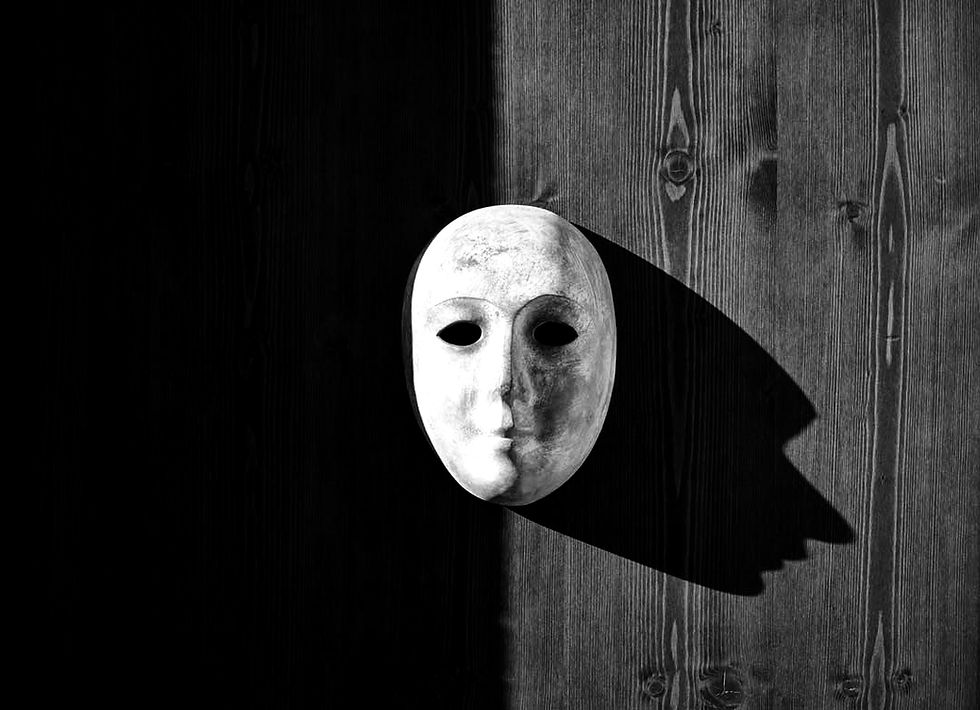
Fetish culture extends this same cultural tradition by exploring identity as something that can be consciously designed, transformed, and reimagined. Masks, hoods, uniforms, and other symbolic garments do not simply conceal the individual beneath them; they create new visual identities that exist alongside everyday life. Rather than functioning as disguises, these objects become tools through which people experiment with presence, role, anonymity, and self-construction, revealing how identity itself can be shaped through material culture, performance, and imagination.
Photography: Envato Elements
Masks
Masks interrupt ordinary recognition. By concealing the face, they shift attention toward posture, clothing, movement, and presence. Rather than erasing identity, masks often create entirely new identities capable of existing outside everyday social expectations.
Their history stretches from religious ritual and theatre to carnival traditions and military protection, making them one of humanity's oldest symbolic objects.
Hoods
Where masks alter appearance, hoods alter presence. Their complete enclosure of the head frequently changes vision, sound, speech, breathing, and spatial awareness, creating a far deeper sense of transformation.
Because they modify sensory experience as well as visual identity, hoods often symbolize immersion, anonymity, depersonalization, and psychological transition rather than simple concealment.
Uniforms
Uniforms replace individuality with role. Military clothing, police uniforms, medical garments, industrial workwear, aviation attire, and ceremonial dress all communicate institutional identity before a person even speaks.
Within fetish culture, uniforms allow participants to explore authority, hierarchy, performance, fantasy, and social identity through clothing. Their symbolism depends less upon the garment itself than upon the institution it references.
Symbols of Transformation
One of the defining characteristics of fetish culture is its fascination with transformation. Rather than simply decorating the body, certain garments and materials fundamentally alter how it is perceived, experienced, and represented. Clothing becomes more than fashion; it becomes a medium through which identity, posture, movement, and even the relationship between the body and its environment can be reimagined.
Throughout history, humans have used dress, ritual costume, cosmetics, and body modification to mark transitions between social roles, ceremonies, occupations, and identities. Fetish culture continues this long tradition by exploring how carefully designed materials can create entirely different versions of the self. A corset reshapes silhouette, high heels reorganize posture, while latex and rubber transform skin into an artificial surface that reflects light rather than absorbing it. These objects do not simply change appearance—they alter perception.
Their symbolism therefore lies not in concealment or decoration, but in the idea that identity is something that can be constructed, designed, and continuously reinterpreted. Transformation becomes both a visual language and a psychological experience, demonstrating how materials possess the power to reshape not only the body, but also the meanings attached to it.

Photography: Envato Elements
Corsets
The corset represents one of fashion history's earliest examples of wearable architecture. Through careful engineering, it reshapes posture, silhouette, and movement while transforming the body into a consciously designed form.
Within fetish culture, the corset symbolizes discipline, elegance, ritual, craftsmanship, and the deliberate reconstruction of identity.
High Heels
High heels transform the body's geometry through a remarkably simple intervention. Raising the heel shifts balance, alters posture, lengthens the apparent line of the leg, and changes the rhythm of walking. Their symbolism therefore extends beyond fashion toward confidence, performance, glamour, theatricality, and bodily transformation.
Latex
Few materials alter visual perception as dramatically as latex. Its reflective surface creates the impression of an artificial second skin where light, movement, and anatomy merge into a single continuous form.
Rather than simply covering the body, latex transforms it into a sculptural surface, explaining its enduring influence within photography, cinema, performance art, fashion, and fetish culture alike.
Rubber
Rubber shares many visual qualities with latex while maintaining its own distinct history rooted in industrial production, protective clothing, waterproof garments, and specialist manufacturing.
Its symbolism often combines technological precision with sensory immersion, creating powerful associations with enclosure, functionality, and material transformation.
PVC
PVC communicates artificiality rather than concealment. Unlike latex, which appears almost biological, PVC embraces the visual language of plastic, gloss, nightlife, cyber aesthetics, and synthetic fashion.
Its highly reflective surface transforms ordinary garments into striking visual objects, making PVC one of the defining materials of contemporary fetish fashion.
Symbols of Structure
Some symbols organize the body not through clothing but through architecture, historical institutions, and spatial relationships.

Photography: Envato Elements
Crosses
The St. Andrew's Cross represents one of fetish culture's most recognizable architectural forms. Beyond its practical function, its symmetrical geometry communicates structure, balance, ritual, and visibility, transforming an ordinary wall into a symbolic environment.
Military Objects
Military equipment carries centuries of associations relating to hierarchy, discipline, engineering, protection, and institutional authority. Boots, belts, gloves, helmets, gas masks, and harnesses all communicate order through design rather than decoration.
Their use within fetish culture reflects the reinterpretation of institutional symbolism rather than its direct continuation.
Boots
Boots ground the body both physically and visually. Whether associated with workers, riders, soldiers, motorcyclists, or leather communities, they communicate stability, durability, movement, and confidence.
Their sound, weight, construction, and silhouette make boots one of fetish culture's most immediately recognizable symbols of physical presence.
Symbols Through Colour
Colour is one of the earliest visual signals processed by the human brain. Long before we consciously interpret shape, material, or detail, colour influences perception, directing attention, evoking emotion, and activating cultural associations that have developed over centuries. Throughout history, colours have been used to communicate authority, danger, spirituality, celebration, mourning, and social status, becoming powerful symbolic languages that extend far beyond aesthetics.
Fetish culture draws upon this broader visual tradition. Colour is rarely a purely decorative element; it shapes atmosphere, reinforces identity, and intensifies the symbolic meaning of clothing, materials, and environments. Certain colours have become particularly significant because they repeatedly appear in fashion, photography, cinema, and underground culture, gradually acquiring meanings that are immediately recognizable within the fetish aesthetic.
Among them, black and red have become the two most enduring colours of fetish visual culture, not because they possess universal meanings, but because they have accumulated remarkably rich cultural histories that continue to influence how they are perceived today.
Black
Black communicates elegance, mystery, authority, anonymity, discipline, and visual unity. It allows texture to dominate over colour, making leather, latex, PVC, rubber, and metal appear simultaneously distinct and cohesive.
Its importance lies not in darkness itself but in its extraordinary ability to organize visual composition.
Red
Red attracts attention faster than almost any other colour. Throughout history it has represented passion, warning, danger, celebration, sacrifice, revolution, and vitality.
Within fetish aesthetics, red often introduces emotional intensity into otherwise restrained environments, functioning as a visual signal rather than merely a decorative choice.
Symbol of Self-Observation
One of the defining characteristics of human consciousness is the ability to observe oneself. Unlike most other species, people continually construct an internal image of who they are, comparing appearance, posture, movement, and behaviour with personal ideals, social expectations, and cultural symbols. Identity is therefore not experienced only from within—it is also shaped by the awareness of how we occupy the world.
Philosophers, psychologists, and sociologists have long argued that the self develops through reflection as much as direct experience. The body becomes something that can be examined, interpreted, modified, and consciously presented. Clothing, gesture, posture, and ritual all contribute to this ongoing process, allowing individuals to shape not only how they are perceived by others but also how they perceive themselves.
Within fetish culture, self-observation often becomes especially pronounced. Materials, garments, environments, and carefully constructed identities encourage heightened awareness of the body as both physical presence and cultural image. Rather than simply expressing desire, fetish aesthetics reveal how identity can be consciously designed, explored, and reimagined. The focus shifts from the body as something merely possessed to the body as something observed, interpreted, and continuously transformed through experience.
Mirrors
Mirrors occupy a unique position because they transform perception rather than the body itself. They allow people to become simultaneously participant and observer, creating multiple perspectives within the same physical space.
Throughout photography, architecture, fashion, and fetish culture, mirrors symbolize reflection, performance, self-awareness, doubling, and the relationship between reality and image. They remind us that identity is not simply lived but continuously observed, interpreted, and reconstructed.
The Visual Language of Fetish
Fetish symbols reveal that objects never remain merely functional. A chain can become connection, a mask can become identity, a corset can become architecture, and a mirror can become self-examination. Materials, colours, clothing, and everyday objects gradually accumulate meanings through history, repetition, community, and imagination until they form a visual language capable of communicating remarkably complex ideas without words.
Seen in this way, fetish symbolism belongs to a much broader history of design and culture. It demonstrates how human beings continually transform ordinary objects into carriers of memory, identity, ritual, authority, and desire. The symbols themselves may evolve, but the underlying process remains constant: people create meaning through the things they make, wear, inhabit, and choose to preserve.
This is why fetish symbols continue to fascinate designers, photographers, filmmakers, historians, and artists. They are not simply objects of desire. They are objects through which culture tells stories about the body, power, transformation, and the endless human capacity to give material form to invisible ideas.
Atomique Fetish Archive
Fetish symbols do not exist in isolation. Every object, material, colour, or garment discussed throughout this article belongs to a broader network of cultural history, psychology, design, and visual representation. Exploring related concepts helps reveal how these symbols evolved across different communities, artistic movements, historical periods, and material traditions.
Within the Atomique Fetish Archive, you can continue exploring the histories behind many of these symbolic languages:
Together, these articles reveal how fetish symbols evolved through history, design, fashion, architecture, psychology, photography, and cinema, creating one of the richest visual languages in contemporary culture.
Written by Otávio Santiago
Founder of Atomique Fetish, an editorial platform exploring fetish design, culture & visual research.
Visual research continues at @atomique.fetish ↗


