


Fetish in the 1920s: Weimar Berlin, Androgyny, Cabaret, and the Surrealist Body
Updated: Aug 13
The 1920s did not invent fetishism, but they profoundly changed the way desire could be seen.

Eldorado Cabaret Weimar Era.
During the final decades of the nineteenth century, European psychiatrists and sexologists had begun constructing a vocabulary for describing sexual fetishism, while literature, photography, fashion, and industrial production were already transforming the relationship between bodies and objects. After the First World War, these previously separate developments entered a radically different cultural environment. Desire moved beyond medical literature and private collections into cabaret, cinema, fashion photography, nightlife, experimental theatre, illustrated magazines, and the artistic avant-garde.
Berlin and Paris became two particularly important laboratories for this transformation. Weimar Berlin developed an extraordinary infrastructure of queer nightlife, sexual reform, publishing, performance, and gender experimentation, while Paris brought together Surrealism, photography, fashion, Black performance, cinema, and a fascination with the psychological power of objects. Across both cities, the body was increasingly treated not as something fixed but as something capable of being dressed, disguised, fragmented, photographed, stylized, and reconstructed.
The organized leather, rubber, BDSM, and fetish communities familiar from the second half of the twentieth century had not yet emerged in their recognizable forms. What the 1920s created instead was one of their essential cultural foundations: a modern visual language in which clothing, materials, objects, and bodily presentation could communicate transformation, authority, ambiguity, anonymity, and desire.
After the First World War: A New Relationship with the Body
Europe entered the 1920s profoundly altered by the First World War. Millions had died, empires had collapsed, political systems had been reorganized, and an entire generation had witnessed the human body subjected to industrialized violence on a scale previously unimaginable. Prosthetics, reconstructive surgery, military uniforms, mechanized transportation, and mass-produced technologies became part of the visual landscape of modernity, while women had entered areas of employment and public life that had previously been overwhelmingly male.
At the same time, everyday life was accelerating. Automobiles, electric lighting, telephones, cinema, radio, photography, advertising, and increasingly sophisticated mass printing technologies were changing how people experienced cities and how images circulated through them. Fashion responded to these transformations by emphasizing mobility and a comparatively liberated silhouette. Hair became shorter, hemlines rose, sports influenced clothing, and the elaborate bodily structures associated with late Victorian fashion lost some of their dominance.
These changes had consequences beyond style. Clothing had always communicated class, profession, gender, and social status, but the 1920s made the deliberate manipulation of those codes particularly visible. A woman in masculine tailoring could appropriate symbols of authority previously associated with men, while stockings and shorter skirts redirected attention toward the leg and shoe. Uniforms continued to communicate institutional power, but the enormous presence of military imagery after the war made their psychological meanings considerably more complicated.
Modernity was demonstrating that the body could be socially redesigned through appearance, and that principle would eventually become central to fetish culture.

Eldorado Cabaret Weimar Era.
Weimar Berlin and the Queer Metropolis
Few cities embodied the contradictions of the decade more intensely than Berlin. Following Germany's defeat in the First World War and the establishment of the Weimar Republic, the capital became a turbulent centre of politics, art, nightlife, publishing, cinema, architecture, sexual research, and experimentation. Economic instability and political violence existed alongside an extraordinary expansion of cultural possibility.
Berlin's queer world was particularly remarkable. Gay men, lesbians, cross-dressing communities, gender-nonconforming people, artists, performers, sex workers, intellectuals, and curious visitors encountered an urban network of bars, cafés, dance halls, associations, publications, and entertainment venues. The Deutsches Historisches Museum describes gay and lesbian subculture as an important part of the development of Germany's homosexual organizations into a mass movement during the Weimar period.
This was not yet the leather Berlin that would emerge much later, and describing the 1920s as an early leather scene would collapse very different historical periods into one another. Its importance to fetish history lies elsewhere. Berlin created an unusually dense infrastructure in which alternative sexualities and gender presentations could move from isolated private experience toward social recognition. People encountered not only other people but also visual codes, terminology, publications, clothing, gestures, and spaces through which identity could be understood.
That concentration mattered. A city could function almost like a communication technology before digital networks existed, allowing people who might otherwise have remained geographically and socially separated to recognize themselves through one another.
Magnus Hirschfeld and Sexuality as a Modern Field of Knowledge
Berlin's sexual culture was not confined to nightlife. In 1919, physician and sexologist Magnus Hirschfeld established the Institute for Sexual Science, creating an institution dedicated to research, consultation, archives, education, and advocacy concerning sexuality and gender.

Hirschfeld and queer community in 20's.
Hirschfeld had already spent decades campaigning against Paragraph 175, the German law criminalizing sexual relations between men, and his work represented a significant departure from approaches that treated every deviation from heterosexual reproductive norms exclusively through pathology. The Institute accumulated an extraordinary library and archive while providing medical and psychological services and becoming internationally associated with research into sexuality and gender.
For the history of fetish culture, the Institute matters because it represents a broader transition taking place during the period. Sexuality was increasingly becoming something around which knowledge, communities, political claims, archives, and identities could be organized. Categories initially constructed within medicine could be encountered by the people they purported to describe, while personal experiences could in turn influence emerging scientific discussions.
The nineteenth century had created many of the diagnostic categories. The early twentieth century increasingly confronted the possibility that the people inside those categories might construct cultures and identities of their own.
Cabaret and the Architecture of Transformation
Berlin's nightlife provided a very different laboratory for the same questions. Venues associated with queer and gender-nonconforming culture, including establishments using the famous Eldorado name, became part of an international image of Weimar Berlin as a city where conventional identities could be suspended after dark.

Eldorado Cabaret Weimar Era.
Cabaret was particularly important because it combined several mechanisms that would later become fundamental to fetish nightlife. Clothing, makeup, choreography, music, lighting, spectatorship, architecture, and performance operated simultaneously, allowing the body to become something consciously constructed for an audience. The separation between performer and spectator could become unstable, while gender presentation could shift through costume, gesture, voice, and theatrical persona.
This is one of the most important connections between Weimar nightlife and later fetish in the 1920's. The relationship is not a simple genealogy in which BDSM clubs somehow descend directly from cabaret, but both demonstrate the psychological power of entering an environment where ordinary social codes are temporarily reorganized. A doorway becomes a threshold between identities; clothing communicates membership or transformation; lighting alters the perception of bodies; and a room can create permission for behaviour that would appear impossible outside it.
The idea that architecture could provide a temporary world for alternative identities was already firmly present.
Marlene Dietrich and the Authority of Masculine Tailoring
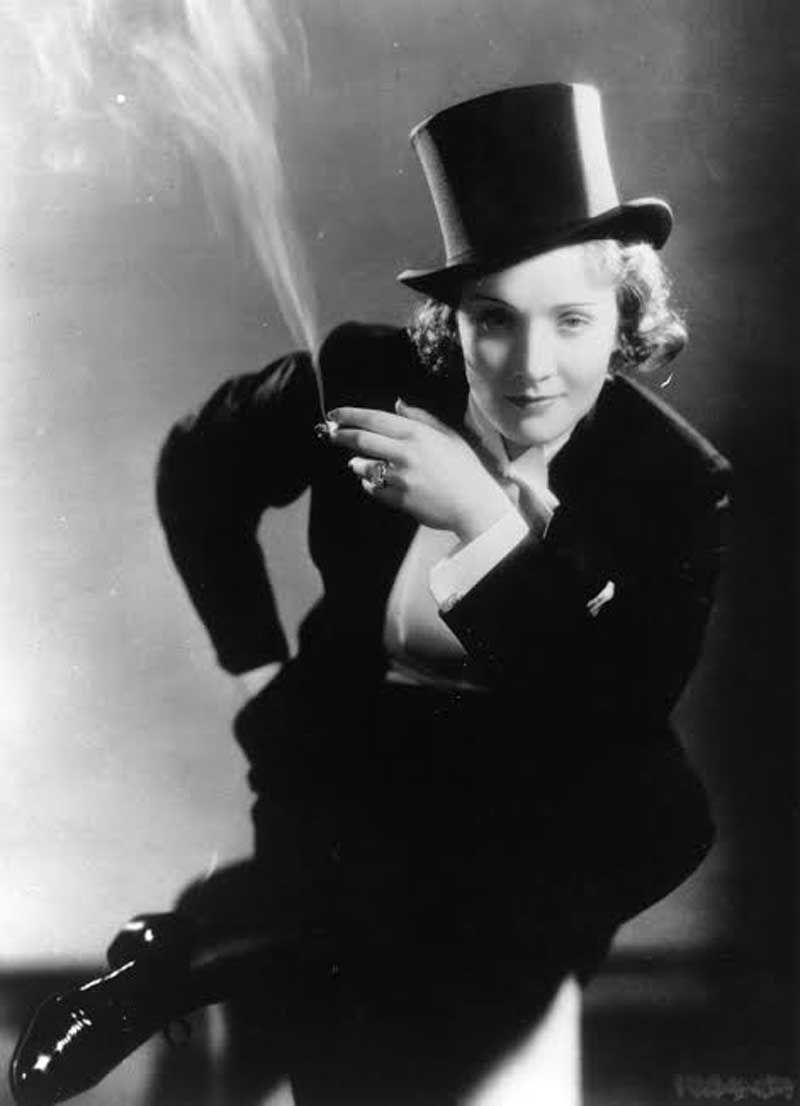
Marlene Dietrich would become an international icon after her appearance in Josef von Sternberg's The Blue Angel in 1930, but her development as a performer belonged deeply to the theatre, revue, cinema, and nightlife culture of 1920s Berlin. Her subsequent use of tuxedos and masculine tailoring became one of the twentieth century's most enduring images of gender ambiguity.
The importance of the suit was not simply that a woman was wearing clothing associated with men. Tailoring carried an existing social vocabulary of authority, professionalism, discipline, wealth, and masculine public power. Structured shoulders, trousers, formal shirts, ties, and tuxedos reorganized the silhouette according to codes historically denied to women. When Dietrich appropriated those codes, she did not erase their masculine associations; she used the tension between those associations and her own carefully constructed femininity.
This mechanism would later become central to fetish fashion. Uniforms, military jackets, police clothing, riding boots, leather caps, corsets, and other garments become psychologically charged partly because they arrive already carrying cultural meaning. Fetish aesthetics rarely invent symbolism from nothing; they appropriate existing symbols and reposition them around another body, another identity, or another fantasy.
Dietrich's significance therefore lies less in labeling her aesthetic “dominatrix” before such an image had fully crystallized than in recognizing how effectively she demonstrated the erotic potential of authority transferred through clothing.
Paris and the Erotic Avant-Garde
While Berlin transformed identity through nightlife and sexual politics, Paris became a laboratory for transforming the relationship between bodies and objects. The aftermath of the First World War produced an avant-garde intensely suspicious of conventional rationality, bourgeois morality, and established artistic traditions. Dada and subsequently Surrealism explored dreams, chance, violence, sexuality, the unconscious, and the unstable meanings hidden inside apparently ordinary things.
For the visual history of fetishism, this obsession with objects was crucial.
Surrealism repeatedly removed things from their expected contexts and forced viewers to encounter them differently. A mannequin could appear disturbingly human, a body could resemble sculpture, a domestic object could become threatening, and an isolated body part could acquire greater visual importance than the complete person. Shoes, gloves, masks, hair, eyes, mouths, legs, and artificial forms could become independent psychological territories.
This way of looking closely resembles one of the central mechanisms of fetish attention: the ability of a fragment, material, surface, or object to accumulate an intensity that exceeds its ordinary function.
Surrealism was not fetish culture, but its artists understood that desire did not necessarily obey the boundaries separating people from things.
Man Ray and the Transformation of the Body into Object

Few artists embodied this instability as clearly as Man Ray, whose photography, objects, and experimental films repeatedly transformed familiar bodies into unfamiliar images.
His 1924 photograph Le Violon d'Ingres, featuring Kiki de Montparnasse photographed from behind with violin f-holes added to her body, remains one of the defining images of Surrealist photography. The transformation is deceptively simple: the human back becomes visually associated with a musical instrument, while the photographed person simultaneously remains a body and becomes an object. The Metropolitan Museum of Art notes this deliberate transformation and the photograph's complicated relationship with objectification.
Its relevance to fetish visual history is precisely this ambiguity. The image demonstrates that erotic intensity can be generated through substitution rather than exposure. Desire moves between the person, the curve of the body, the imagined object, the photographic surface, and the viewer's own associations.
Man Ray explored related ideas throughout the decade in experimental films including Retour à la raison (1923), Emak-Bakia (1926), and L'Étoile de mer (1928), where bodies, shadows, objects, movement, and abstraction repeatedly destabilize straightforward representation.
The fetish photography that developed later in the century would employ many comparable visual strategies, even when its cultural context was entirely different: isolate the detail, emphasize the surface, fragment identity, intensify material, and allow the object to compete with the human body for attention.
Kiki de Montparnasse and the Agency Behind the Image
The mythology surrounding avant-garde photography often concentrates so heavily on photographers that the people inside their images become almost invisible. Kiki de Montparnasse, born Alice Prin, demonstrates why this approach is inadequate.
Kiki was not merely Man Ray's model. She was a performer, painter, singer, celebrity, and central participant in Montparnasse culture whose public persona was constructed through her own involvement in the artistic and nightlife worlds of Paris. Her relationship with Man Ray lasted through much of the decade, and her image became inseparable from some of the most recognizable photographs of interwar modernism.

Kiki de Montparnasse.
Her presence introduces a question that would remain important throughout the history of fetish photography: where does objectification end and performance begin? A photographed body may be deliberately presented as an object while the person being photographed participates actively in constructing the image. Posture, styling, expression, gesture, costume, and the conscious presentation of the self complicate any simple distinction between subject and object.
Fetish visual culture would repeatedly inhabit precisely this ambiguity.
The Surrealist Object and the Erotic Potential of Things
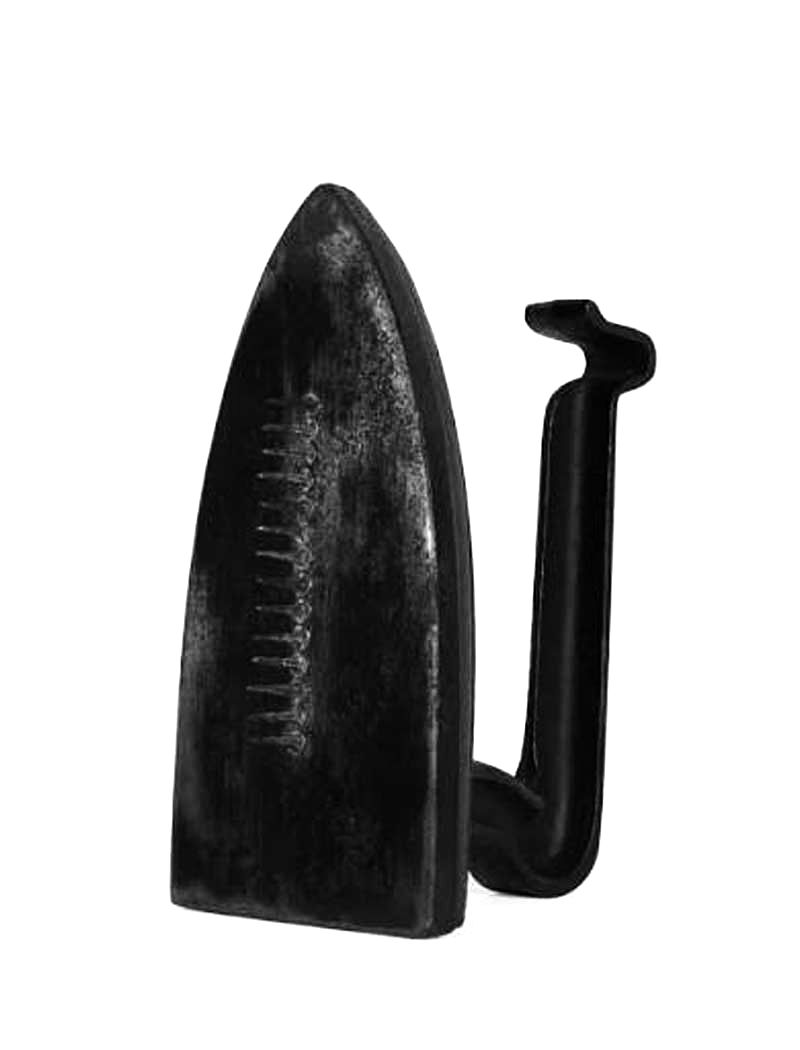
Man Ray's fascination with objects provides another bridge between Surrealism and the later fetish imagination. In Cadeau (1921), he transformed an ordinary iron by attaching metal tacks to its surface, making a familiar domestic object suddenly unusable, aggressive, and psychologically unstable. His 1923 Object to Be Destroyed similarly transformed a metronome through the addition of an eye, giving mechanical repetition an uncanny human presence.
These works are not sexual fetish objects in the contemporary sense, but their conceptual mechanism is extremely relevant. They demonstrate that the meaning of an object is never entirely contained within its practical function. Once context changes, utility can become symbolism, domestic familiarity can become threat, and an anonymous manufactured object can acquire something resembling personality.
Modern fetish culture repeatedly performs similar transformations. A collar changes meaning when removed from animal handling and incorporated into a human relationship; a military boot can move from institutional equipment into fashion and fetish identity; medical furniture can be detached from the clinic and transformed into theatrical or erotic design; industrial rubber can become clothing; and a gas mask can move from protective technology toward anonymity, transformation, and visual fantasy.
Objects travel between worlds, and each journey leaves additional meanings attached to their surfaces.
Josephine Baker and the Construction of the Erotic Persona

Paris offered another model of transformation through Josephine Baker, who arrived in the city in 1925 and became an international sensation after appearing in La Revue Nègre. Her performances subsequently at the Folies Bergère made her one of the most photographed and recognizable performers of the interwar period.
Baker's enormous fame was inseparable from the racial politics of European modernism. White European audiences frequently interpreted Black performers through colonial fantasies of exoticism, primitivism, hypersexuality, and supposed naturalness, and the imagery constructed around Baker repeatedly participated in these stereotypes. Any account of her influence on erotic visual culture needs to acknowledge that context rather than treating her image as uncomplicated liberation.
At the same time, Baker possessed extraordinary command over performance. Choreography, costume, facial expression, humour, movement, publicity, and photography became components of a consciously managed public identity. She demonstrated that erotic spectacle could be manufactured through performance rather than simply produced through nudity, and that the body could function as a designed visual event whose meanings changed according to costume, movement, lighting, and audience.
This idea—that erotic identity can be deliberately constructed rather than simply revealed—would become increasingly important throughout the twentieth century.
Absolutely. This section is repeating several ideas already established earlier in the article, especially around transformation, objects, materials, photography, and identity. I would cut it by well over 50% and make the remaining sections work harder.
Masks, Faces, and Anonymity
The avant-garde fascination with masks introduced a visual mechanism that would later become important to fetish culture. European artists encountered African and Oceanic ceremonial objects through colonial networks, frequently removing them from their original contexts and interpreting them through racialized ideas of abstraction, sexuality, and the unconscious.
Man Ray's Noire et blanche (1926), juxtaposing Kiki de Montparnasse with an African mask, belongs to this complicated history while also exploring symmetry, surface, objectification, and unstable identity. Concealing the face changes how the entire body is perceived, redirecting attention toward silhouette, posture, clothing, and material, a principle later developed through fetish hoods, masks, helmets, and blindfolds.

Stockings, High Heels, and the Modern Body
Shorter skirts made stockings, ankles, calves, and footwear considerably more visible during the 1920s, while cinema, advertising, dance, and fashion photography amplified their presence. Stockings transformed skin through an artificial layer, while high heels changed posture, gait, balance, and silhouette, establishing a relationship between clothing and bodily transformation that would become fundamental to fetish fashion.
Photography intensified this attention by isolating details, allowing a shoe, stocking, glove, or leg to become the central subject rather than simply one element of an outfit.
Rubber and the Artificial Surface
Industrial modernity expanded the vocabulary of materials associated with the body. Rubberized fabrics brought impermeability, smoothness, pressure, smell, and an unmistakably artificial surface into clothing and protective equipment.
Although rubber would become a recognizable fetish material later, the interwar period established an important connection between desire and the material culture of modern industry. The fetish wardrobe could increasingly draw from the hospital, factory, laboratory, military institution, and machine rather than exclusively from traditional fashion.
Yva Richard and Commercial Fetish Fashion

Parisian company Yva Richard became an important interwar producer of lingerie, corsetry, footwear, and specialized garments distributed through international mail order. Its importance lies in the transition from conventional garments becoming fetishized to clothing being intentionally produced and marketed around particular fantasies.
This combination of garment, catalogue, image, and customer anticipated the commercial structure later used by specialist leather and rubber makers, bondage catalogues, fetish magazines, and contemporary online stores.
Cinema, Photography, and Portable Desire
Cinema and photography transformed desire by separating images from physical presence. Close-ups isolated faces, clothing, gestures, and objects, while celebrity culture allowed audiences to develop intense familiarity with people they had never encountered.
A boot, uniform, performer, or particular gesture could now circulate independently through reproducible images, establishing a mechanism that would later define pin-up photography, fetish magazines, underground cinema, video, and eventually digital culture.
The 1920s and the Making of a Fetish Aesthetic
The importance of the 1920s lies in the convergence of these developments. Weimar nightlife created spaces where sexuality and gender could be performed collectively, Surrealism destabilized relationships between bodies and objects, fashion made gender codes increasingly available for manipulation, and photography and cinema transformed those experiments into reproducible images.
Figures such as Josephine Baker, Marlene Dietrich, Man Ray, and Kiki de Montparnasse demonstrated different possibilities for constructing identity through costume, movement, photography, and performance, while stockings, heels, rubber, and specialist businesses such as Yva Richard expanded the material world surrounding desire.
This experimentation was fragile. The economic crisis beginning in 1929 was followed by the destruction of much of Germany's queer and sexual-reform culture after the Nazi seizure of power in 1933, including the attack on Magnus Hirschfeld's Institute for Sexual Science and intensified persecution of homosexual men.
The nineteenth century had helped give fetishism a name. The 1920s began giving it a modern visual language built from clothing, objects, materials, performance, photography, and identity. The 1930s would take that language into darker territory through Surrealism, Hans Bellmer's dolls, Brassaï's nocturnal Paris, specialized photography, and the increasingly disturbing relationship between uniforms, discipline, spectacle, and authoritarian power.
Related Concepts
Androgyny
Stocking Fetish
Body Transformation
Written by Otávio Santiago
Founder of Atomique Fetish, an editorial platform exploring fetish design, culture & visual research.
Visual research continues at @atomique.fetish ↗


