


Fetish in the 1930s: Surrealism, Nightlife, Authoritarian Aesthetics, and the Fragmented Body
The 1930s inherited the visual experiments of the previous decade but transformed them under far more unstable political conditions. The optimism and cultural permissiveness associated with parts of the 1920s gave way to economic crisis, authoritarianism, fascism, censorship, exile, and war. Yet fetish imagery did not disappear. It became darker, more psychologically complex, and increasingly entangled with questions of control, fragmentation, discipline, spectacle, and the body under pressure.
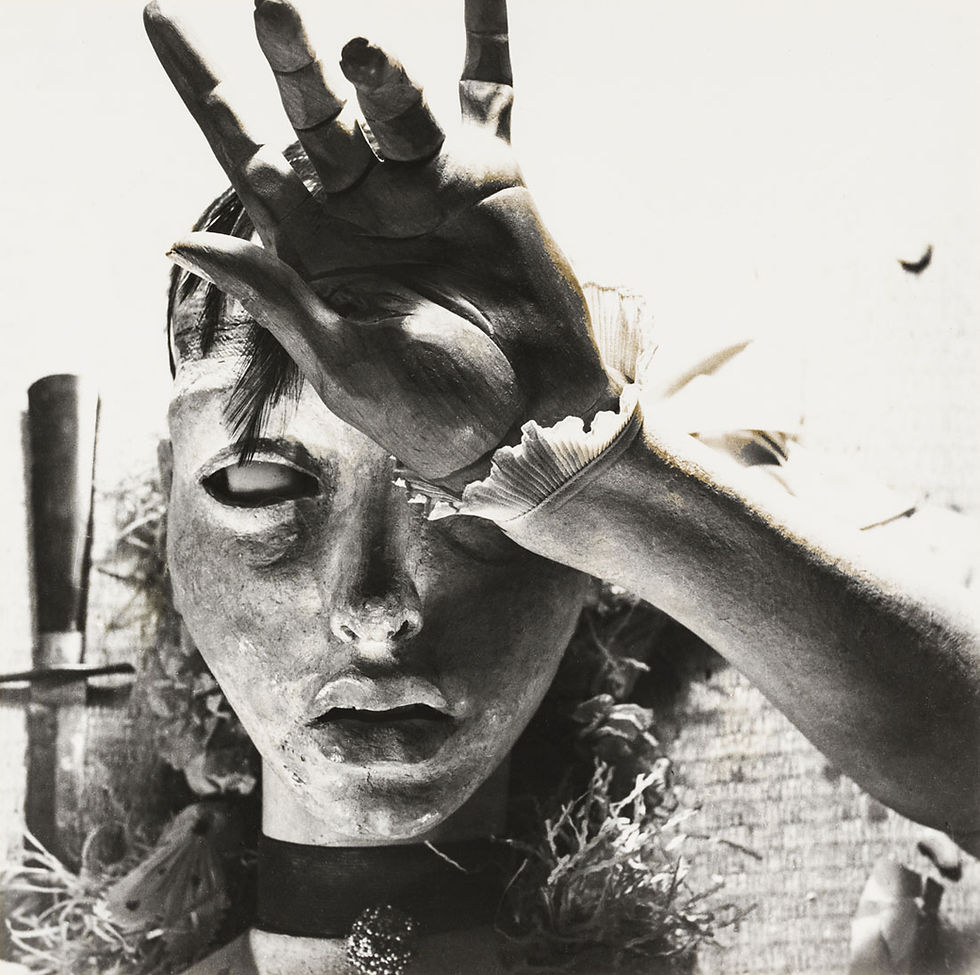
Hans Bellmer.
Paris remained a crucial center for Surrealism and nocturnal photography, while Berlin's once-flourishing queer and sexual-reform cultures were violently dismantled after 1933. Artists including Hans Bellmer pushed the representation of the body toward disassembly and reconstruction, Brassaï documented the hidden night worlds of Paris, and specialized photography continued to explore stockings, corsetry, shoes, masks, bondage, and theatrical femininity.
At the same time, authoritarian regimes transformed uniforms, disciplined bodies, military spectacle, and carefully controlled visual propaganda into some of the most powerful aesthetic systems of the century.
The decade therefore occupies a uniquely uneasy place in the history of fetish culture. The visual codes of authority, control, bodily transformation, and objectification were becoming more recognizable precisely as political systems were demonstrating how terrifying those same codes could become when transferred from fantasy into real institutional power.

Brassaï.
The End of Weimar and the Destruction of a Sexual Culture
The 1930s began with one of the most dramatic reversals in modern sexual history. The queer nightlife, sexual research, publishing networks, and reform movements that had made Weimar Berlin internationally famous came under immediate attack after the National Socialists seized power in 1933.
Magnus Hirschfeld's Institute for Sexual Science was raided and destroyed, its archives looted, and books from its collection publicly burned. Gay and lesbian organizations were dissolved, venues closed, publications suppressed, and the increasingly aggressive enforcement of Paragraph 175 intensified the persecution of homosexual men. The same city that had previously demonstrated how urban density could create visibility and community now demonstrated how rapidly that visibility could become dangerous.
This transformation matters to fetish history because it reveals that subcultures depend upon infrastructure. Bars, clubs, magazines, organizations, bookstores, private networks, and archives are not incidental to cultural identity; they are what allow identities to become visible and transmissible. When those structures disappear, the culture does not simply retreat—it loses the spaces through which memory and community are maintained.
The repression of queer Berlin therefore created a historical rupture whose consequences extended far beyond Germany.
Surrealism Becomes Darker
In Paris, Surrealism continued to develop, but the tone of the decade became increasingly uneasy. The movement's earlier fascination with dreams, objects, sexuality, and the unconscious remained, yet fragmentation, violence, anxiety, and bodily instability became more prominent.
The Surrealist body was rarely presented as whole or secure. It could be cropped, multiplied, distorted, replaced, assembled from unrelated parts, or transformed into sculpture. The distinction between subject and object became increasingly unstable, and that instability is highly relevant to the later visual language of fetish culture.
Rather than celebrating the body as a unified natural form, Surrealism treated it as something that could be reconfigured. Limbs, eyes, mouths, stockings, hair, shoes, masks, and prosthetic forms could function independently, acquiring psychological intensity through isolation. This logic closely resembles the process through which fetish attention can concentrate meaning into a particular material, object, body part, or visual detail.
The body became less an anatomical certainty than a field of possibilities.
Hans Bellmer and the Doll as a Fetish Object
Few artists represent the darker psychology of the 1930s as forcefully as Hans Bellmer. Beginning in the early part of the decade, Bellmer constructed articulated dolls that he photographed in elaborate and frequently disturbing configurations. Limbs were multiplied, torsos fragmented, joints exposed, and bodily structure made deliberately unstable.
Bellmer's dolls occupy a complicated position within art history because they are simultaneously sculptural objects, representations of the body, and objects through which desire and violence become difficult to separate. Their significance to the history of fetish imagery lies in the transformation of the body into something modular, manipulable, and partially artificial.
The doll removes one of the fundamental distinctions of portraiture: there is no autonomous person behind the image. The body can therefore be rearranged without resistance, becoming pure construction. This introduces themes that would later recur across fetish visual culture, including mannequin fetishism, dollification, objectification, artificial bodies, body modification, and the erotic ambiguity of figures that appear human while remaining unmistakably manufactured.
Bellmer did not create these later subcultures, but his work exposed a psychological territory they would eventually explore in very different contexts.
Brassaï and the Night City
If Bellmer transformed the body into an object, Brassaï transformed Paris itself into an erotic environment. His photography of the city at night documented bars, streets, hotels, prostitutes, lovers, dancers, artists, criminals, and underground social worlds that existed outside the respectable daylight image of Paris.
His 1933 book Paris de nuit helped establish nocturnal urban photography as a distinct visual language. Darkness softened architectural details, isolated bodies, intensified reflections, and transformed ordinary streets into spaces of ambiguity. Artificial light became theatrical, while doors, mirrors, corridors, cafés, staircases, and hotel rooms acquired psychological weight through photography.
This urban atmosphere is important to fetish history because subcultures often depend upon the transformation of ordinary space. A street at midday and the same street after midnight are architecturally identical but culturally different. Lighting, anonymity, traffic patterns, opening hours, music, clothing, and social expectation collectively reorganize the environment.

Brassaï.
Brassaï documented this transformation with unusual sensitivity, demonstrating how desire can become spatial.
Photography and the Fetish Detail
The 1930s further consolidated photography's ability to isolate and intensify details. Advertising, fashion magazines, cinema publicity, postcards, and specialist photography increasingly circulated images of stockings, gloves, shoes, lingerie, corsets, uniforms, and carefully staged bodies.
This expansion mattered because fetish imagery does not require the entire body to remain visible. A photograph can isolate a heel, crop a face, emphasize a gloved hand, or reduce a person to a silhouette. Photography directs attention by excluding information, allowing one material or object to become disproportionately important.
The visual logic of fetishism and the visual logic of photography therefore became increasingly compatible. Both depend on concentration, framing, repetition, and the possibility that a fragment can acquire more significance than the whole.
This principle would later become fundamental to bondage photography, pin-up imagery, fetish catalogues, fashion editorials, and eventually digital image culture.
Corsetry, Lingerie, and the Persistence of Structured Femininity
Although mainstream fashion moved away from the heavily corseted silhouettes of the nineteenth century, structured undergarments did not disappear. Girdles, corsets, stockings, garters, brassieres, gloves, and carefully shaped lingerie continued to organize the body according to changing ideals of femininity.
The visual distinction is important. The modern body was increasingly presented as streamlined, but that apparent naturalness still depended upon engineered clothing. Structure had moved inward.
This tension between appearance and construction became central to fetish fashion. A garment could create the impression of natural elegance while physically organizing posture, compression, contour, and movement underneath the visible clothing.
Specialized fetish fashion would later make that hidden structure visible again, exposing lacing, boning, buckles, straps, and seams as design features rather than concealing them. The 1930s therefore belong to a transitional moment when the technologies of bodily control remained present even as fashion attempted to make them appear more discreet.
Yva Richard and the Specialized Fetish Wardrobe
Specialist businesses such as Yva Richard continued developing the commercial relationship between lingerie, fantasy, photography, and mail-order culture. Their imagery circulated garments that emphasized corsetry, high heels, stockings, gloves, and theatrical forms of femininity that already stood apart from conventional fashion.

This is where the distinction between fashion that becomes fetishized and fashion designed with fetish appeal becomes increasingly important. A normal garment can acquire symbolic meaning through context, but specialized producers increasingly understood that materials, silhouettes, accessories, and photographic presentation could be designed specifically to stimulate fantasy.
The catalogue itself became part of the experience. Customers did not simply purchase clothing.
They encountered a visual world constructed through models, poses, styling, typography, and carefully staged images. The commercial object and the fantasy surrounding it became inseparable. That model would later define fetish publishing and retail for decades.
Masks, Veils, and Controlled Identity
The fascination with concealment continued throughout the 1930s across fashion, theatre, cinema, Surrealism, and performance. Masks, veils, hats, shadow, and theatrical makeup all altered the relationship between face and identity.
The importance of the face lies in its role as the primary social marker of individuality. Once partially hidden, the body becomes available for reinterpretation. Posture, silhouette, clothing, and movement begin carrying more of the burden of identity.
Later fetish culture would develop this mechanism more explicitly through leather hoods, gas masks, rubber masks, blindfolds, helmets, and other forms of concealment, but the broader visual fascination with the obscured face was already well established.
Anonymity was becoming a designed effect.
Uniforms and the Politics of Authority
The 1930s also made the symbolism of uniforms impossible to separate from politics.
Authoritarian regimes understood that clothing could communicate hierarchy, discipline, unity, and ideological belonging more efficiently than language alone. Military uniforms, insignia, boots, belts, caps, coats, gloves, and carefully choreographed mass formations created a visual system in which political authority became instantly legible.
This history is essential when discussing fetish aesthetics because uniforms later became recurring symbols within fetish culture. Their appeal cannot be understood solely through abstract concepts such as discipline or authority; military clothing carries historical associations with institutions, violence, nationalism, and systems of real coercion.
Fetish culture often reinterprets uniforms within consensual symbolic contexts, but the original histories remain present in the image. Treating all military aesthetics as neutral styling risks erasing the political conditions that gave those garments their authority in the first place. The 1930s demonstrated with terrifying clarity that visual power can be manufactured.
The Body as Political Instrument
Authoritarian aesthetics extended beyond clothing into the body itself. Physical fitness, racial ideology, masculinity, motherhood, military preparedness, sport, and idealized anatomy became central elements within political propaganda.
The body was no longer simply personal. It became evidence. A disciplined male physique could represent military readiness; a carefully idealized female body could symbolize reproduction and national continuity; athletic spectacle could become proof of collective strength. Photography and cinema amplified these representations, transforming bodies into symbols of political ideology.
This history complicates the later eroticization of discipline, uniform, and physical perfection. Fetish culture would eventually appropriate many of these visual codes, but the 1930s reveal their darker institutional history. Bodies can be aestheticized, but they can also be regulated.
Cinema, Censorship, and Controlled Desire
Cinema became one of the dominant cultural technologies of the 1930s, but its expanding influence was accompanied by intensified regulation. In the United States, enforcement of the Hays Code from 1934 imposed strict limitations on representations of sexuality, homosexuality, adultery, nudity, and other subjects considered morally unacceptable.

Hays Code.
Censorship did not eliminate desire from cinema. It changed how desire was represented. Clothing, gesture, lighting, implication, coded dialogue, camera angles, and symbolism became increasingly important because filmmakers could no longer rely upon direct representation. Desire moved into suggestion.
This indirect visual language had unexpected consequences. Gloves, stockings, cigarettes, doors, shadows, uniforms, mirrors, and objects could become loaded with meanings precisely because explicit sexuality was restricted.
Censorship taught popular cinema to eroticize the detail. That visual strategy would later become extraordinarily important to fetish aesthetics.
Hollywood Glamour and the Artificial Body
The 1930s also perfected the manufacturing of celebrity beauty through studio photography, makeup, lighting, costume, and retouching. Hollywood stars were carefully constructed public images whose bodies were mediated through layers of design.
Hair, eyebrows, lips, skin tone, gowns, heels, gloves, jewellery, and posture were standardized according to elaborate visual systems. The screen body was not presented as ordinary reality but as controlled illusion.
This manufactured glamour shares an important principle with fetish aesthetics: identity can be intensified through artificiality.
Later latex, rubber, PVC, extreme makeup, corsetry, drag, body modification, and fetish fashion would use artificial transformation far more explicitly, but Hollywood had already demonstrated the commercial power of a body deliberately redesigned for the image.
The camera did not simply document beauty. It manufactured it.
Leather Before Leather Culture
Leather remained present throughout the decade as military equipment, workwear, riding gear, boots, gloves, protective clothing, and motorcycle equipment, but organized gay leather culture had not yet emerged in the recognizable postwar form.
This distinction is historically important because the material's later erotic symbolism was built upon meanings accumulated through earlier uses. Leather already communicated durability, physical labour, protection, horses, military authority, machinery, and masculine utility.

Tom of Filand.
When later motorcycle and gay leather communities adopted the material, they inherited this entire symbolic history. The 1930s therefore belong to leather's prehistory as a fetish language. The codes were present, but the community that would consciously assemble them into identity was still to come.
Rubber, Gas Masks, and the Industrial Body
Industrial modernity continued expanding the range of synthetic and technical materials surrounding the body. Rubber appeared in medical equipment, protective clothing, waterproof garments, industrial applications, and military technology, while the growing fear of chemical warfare made the gas mask one of the most unsettling objects of the interwar period.
Gas masks are particularly important within later fetish visual culture because their design completely transforms the human face. Glass lenses replace eyes, filters distort breathing, rubber seals the skin, and straps reconstruct the head as a mechanical object.
During the 1930s, however, this imagery was connected primarily with fear, civil defense, military preparation, and the memory of chemical warfare from the First World War. Its later migration into fetish imagery demonstrates how dramatically objects can change meaning across historical contexts. The same object can represent survival in one generation and transformation in another.

Photography: Envato Elements
Exile and the Movement of Visual Culture
The rise of fascism forced artists, intellectuals, scientists, queer people, Jewish communities, political dissidents, and cultural figures to flee Germany and other parts of Europe. This displacement had profound consequences for modern visual culture because ideas, techniques, archives, and artistic networks travelled with them.
Berlin's experimental culture did not simply vanish; fragments of it moved to Paris, London, New York, Los Angeles, and elsewhere. European modernism entered new contexts, influencing photography, cinema, theatre, design, psychology, and fashion across the Atlantic.
Fetish visual history would later develop through exactly these international networks.
Images rarely remain where they are created.
The 1930s and the Architecture of Secrecy
As repression intensified, privacy once again became essential. Queer and unconventional sexual communities increasingly depended upon discreet apartments, private gatherings, coded networks, bars, hotels, parks, and semi-public environments where recognition could occur without attracting institutional attention.
Architecture became a technology of concealment.
Curtains, locked doors, back rooms, basements, hotel corridors, private clubs, and anonymous entrances provided forms of protection. The spatial organization of secrecy would later remain important to leather bars, BDSM clubs, darkrooms, and other fetish spaces even after legal conditions changed.
The relationship between fetish culture and hidden architecture therefore developed not purely from theatrical preference but also from historical necessity.
Desire Under Pressure
The 1930s demonstrate that fetish history cannot be separated from political history. The decade inherited many of the visual experiments of the 1920s but reorganized them through economic instability, censorship, authoritarianism, exile, and approaching war.
Surrealism fragmented the body while Bellmer reconstructed it through artificial dolls. Brassaï transformed nighttime Paris into an archive of hidden urban life. Fashion and specialist photography continued refining the visual language of stockings, heels, corsetry, lingerie, and controlled femininity. Cinema learned to communicate sexuality through suggestion because censorship restricted direct representation, while authoritarian regimes demonstrated how effectively uniforms, architecture, spectacle, and disciplined bodies could transform political power into visual culture.
These histories are not interchangeable, but they intersect around a central problem that would remain fundamental to fetish culture throughout the twentieth century: the relationship between body and control.
Control can be voluntary or imposed, theatrical or institutional, aesthetic or political. The same visual symbol can shift dramatically depending on context, which is precisely why the history behind fetish imagery matters.
A Decade of Fragmentation
If the 1920s made transformation visible, the 1930s made fragmentation unavoidable.
The body could be reconstructed by the artist, regulated by the state, idealized by cinema, shaped by fashion, hidden by architecture, or converted into an object through photography. Identity became simultaneously more visually sophisticated and more politically vulnerable.
This tension marks the decade as one of the most important transitional periods in the history of modern fetish aesthetics. Many visual codes that later became recognizable within fetish culture—uniforms, boots, masks, artificial bodies, structured lingerie, industrial materials, controlled posture, anonymity, and the eroticized fragment—were becoming increasingly powerful, but their meanings remained unstable and sometimes deeply disturbing.
The next decade would transform the landscape again. The Second World War would mobilize uniforms, rubber, leather, medical equipment, restraints, machinery, and industrial materials on an unprecedented scale, while postwar America would produce pin-up photography, mail-order fetish imagery, John Willie's Bizarre, Irving Klaw, Bettie Page, and the early visual world from which modern fetish publishing would emerge.
The underground fetish culture of the 1940s and 1950s would therefore grow directly out of a world transformed by war, censorship, industrial production, and the enormous expansion of reproducible imagery.
Related Concepts
Military Fetish
Stocking Fetish
Mannequin Fetish
Fetish Photography
Written by Otávio Santiago
Founder of Atomique Fetish, an editorial platform exploring fetish design, culture & visual research.
Visual research continues at @atomique.fetish ↗


