


Kiki de Montparnasse surrealism fetish muse Man Ray
Kiki de Montparnasse was not merely photographed — she was constructed as desire. In the hands of surrealists, especially Man Ray, she became an erotic language: part muse, part lover, part fetishized form, part liberated woman. Her body, gaze, and posture helped define how modern art would imagine femininity, sexuality, and power.
We recognize Kiki not as passive inspiration, but as an active participant in the birth of fetish aesthetics within surrealism.

Who Was Kiki de Montparnasse?
Born Alice Prin in 1901, Kiki rose from poverty to become the living symbol of Paris’s avant-garde. She was a model, singer, painter, writer, and provocateur — deeply embedded in the artistic circles of Montparnasse during the 1920s.
More than anything, Kiki embodied sexual autonomy at a time when female desire was still tightly policed. She lived openly, loved freely, and refused to be reduced to respectability.
She was not discovered.
She arrived.
Man Ray and Kiki — When Muse Becomes Fetish
Kiki’s relationship with Man Ray was both romantic and artistic.
Together, they created some of the most iconic images of the 20th century — photographs that subtly introduced fetish logic into fine art.
In works such as Le Violon d’Ingres and Noire et Blanche, Kiki’s body becomes:
fragmented
framed
transformed into object and symbol
eroticized through restraint and pose
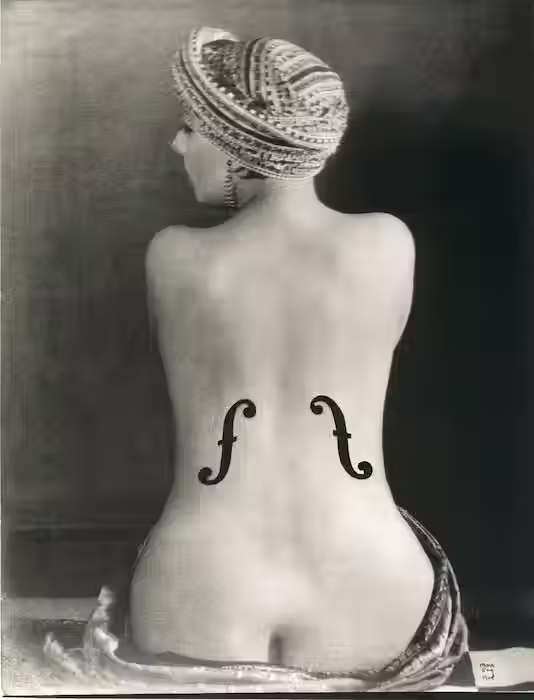
Though not explicit, these images operate through fetish principles: partial concealment, control of the gaze, transformation of the body into artifice.
Kiki was not reduced to an object — but she played with objectification, bending it to her advantage.

The Fetishization of Form
What made Kiki revolutionary was not nudity, but intention.
Her presence allowed surrealism to explore:
the erotic charge of stillness
the power of containment
the beauty of the body as structure
the tension between agency and display
In this sense, Kiki became an early bridge between fetish imagery and high art. She helped normalize the idea that erotic form could be intellectual, symbolic, and culturally meaningful.
The fetish was not hidden — it was aestheticized.
Feminine Power, Not Submission
Unlike later fetish archetypes, Kiki did not embody submission. Her erotic power came from confidence, visibility, and defiance.
She gazed back. She laughed loudly. She drank, performed, posed, wrote.
This mattered deeply: fetish culture often revolves around power exchange, and Kiki represented a woman who chose visibility and controlled how she was seen.
She was not owned by the gaze.
She collaborated with it.
Kiki’s Influence on Fetish and Erotic Culture
Kiki’s image influenced generations of artists and photographers who later shaped fetish culture:
Man Ray’s formal eroticism
Helmut Newton’s empowered female sexuality
Robert Mapplethorpe’s art-fetish crossover
contemporary fetish photography’s emphasis on pose, form, and ritual
She helped establish the visual grammar of erotic art where desire is suggested, not consumed.
Why Kiki Still Matters Today
In modern fetish and queer communities, Kiki resonates as:
a symbol of sexual autonomy
an early icon of body confidence
a woman who refused moral containment
a reminder that fetish can be aesthetic, political, and liberating.

Kiki as Living Fetish Myth
Kiki de Montparnasse was not a fantasy created by men — she was a woman who understood desire and performed it with intelligence.
She blurred the line between muse and maker, fetish and freedom, body and art.
In her image, surrealism learned how to seduce. In her presence, fetish found elegance.
At Atomique, we honor Kiki as more than history. She remains a living archetype — proof that erotic power, when claimed consciously, becomes culture.
Written by Otávio Santiago
Founder of Atomique Fetish, an editorial platform on fetish design
Cultural designer & researcher


