


Wendy Carlos: Synthesizers, Transformation and the Architecture of Electronic Sound
Before electronic music became inseparable from nightclubs, synthesizers, sequencers, machines, artificial environments and the visual language of technological culture, electronic sound was largely confined to laboratories, universities and experimental studios, where enormous equipment produced music that many listeners regarded as difficult, academic or futuristic. Wendy Carlos changed that relationship by demonstrating that the synthesizer was not simply capable of producing strange noises from an imagined future, but could become an extraordinarily precise instrument through which music itself could be reconstructed.
Her breakthrough album, Switched-On Bach, released in 1968, became one of the recordings that introduced the Moog synthesizer to a mass audience, eventually helping establish electronic instruments across classical, rock, dance and popular music. The Library of Congress later selected the album for the National Recording Registry, describing its role in bringing the Moog to a far wider public and noting how extensively its individual electronic voices had to be recorded and assembled.
Carlos is interesting beyond the history of the synthesizer, because her work appeared at the beginning of a cultural transformation that would eventually make machines, artificial surfaces, repetition, technological control and constructed identity central to the aesthetics of electronic music, experimental cinema, underground fashion and nightlife.
Carlos was not making fetish music, and describing her work that way would distort its history. What she helped establish was something broader: an electronic vocabulary in which the artificial no longer needed to imitate the natural apologetically, because technology itself could become beautiful.

Before Electronic Music Became Electronic Culture
By the 1960s, electronic music already possessed a substantial experimental history, but much of it remained geographically and institutionally concentrated inside universities, broadcasting studios and avant-garde composition, where tape manipulation, oscillators and early electronic instruments allowed composers to investigate sound beyond the conventional orchestra.
The synthesizer began changing that relationship because it offered something conceptually different from simply recording an existing instrument. Sound could now be generated electrically and constructed from fundamental components, with oscillators producing waveforms while filters, envelopes and other modules altered their shape, duration and character.
Carlos encountered this technology with both musical training and a technical understanding of electronic sound, having studied at Brown University before continuing at the Columbia-Princeton Electronic Music Center, one of the major centers of American electronic composition. When she encountered Robert Moog's developing modular synthesizer systems, she recognized possibilities that extended far beyond the novelty effects for which electronic instruments were frequently used. The synthesizer could become an instrument, but first musicians had to invent ways of playing it.
Switched-On Bach and the Construction of Impossible Performance
When Switched-On Bach appeared in 1968, its central gesture was simultaneously conservative and radical: Carlos took the music of Johann Sebastian Bach, one of the most structurally disciplined composers in Western music, and reconstructed it through an instrument associated with the technological future.
The choice of Bach was crucial because his compositions provided an almost architectural framework against which the synthesizer could demonstrate precision, articulation and complexity. Rather than hiding behind abstraction, electronic sound was being asked to perform music whose structures listeners already knew.
The production process was extraordinarily laborious. Early Moog systems were essentially monophonic, meaning that complex polyphonic arrangements could not simply be performed as they would be on a piano or organ; individual lines had to be created, recorded and carefully layered onto tape until separate electronic voices became an ensemble. The finished recording therefore blurred distinctions between composition, performance, synthesis, recording and engineering.
A musical performance that appeared unified to the listener had actually been assembled piece by piece. This is where Carlos becomes especially important to the later history of electronic music, because the studio was no longer simply documenting a performance that had already happened somewhere else. The recording itself was the performance.
That principle would eventually become fundamental to electronic music.
The Synthesizer Changed the Meaning of an Instrument
Traditional instruments contain physical relationships that have developed over centuries: a violinist draws a bow across strings, a pianist strikes keys connected to hammers, while a drummer transfers bodily force directly onto a membrane or surface. The musician learns how the object responds and gradually develops control through repeated physical interaction.
A modular synthesizer rearranged this relationship because its identity was not fixed in the same way. Cables could reroute signals, oscillators could generate different waveforms, filters could remove frequencies, envelopes could reshape the evolution of a sound, and voltage could control parameters that traditional instruments connected directly to physical gesture. The instrument became something that had to be configured before its final character fully existed.
Carlos understood this architecture unusually well and worked closely with Robert Moog during the development of his instruments, offering feedback that contributed to their practical evolution as musical tools. Her recordings demonstrated not only what a synthesizer sounded like, but how much expressive precision could emerge from understanding the machine as a system rather than approaching it as a collection of spectacular effects.
This introduced an idea that would later become completely ordinary within electronic music: the musician could also be a programmer, technician, sound designer and architect.
Control Became Part of the Aesthetic
There is a particular quality running through much of Carlos's work that separates it from the fantasy of electronic music as spontaneous technological chaos, because her sound frequently emerges through extraordinary discipline, calibration and microscopic control.
Electronic composition made it possible to manipulate characteristics that acoustic instruments often bundle together, allowing timbre, envelope, pitch, spatial placement and dynamics to be treated as independent design decisions. Instead of accepting the sound supplied by an instrument, the musician could begin much earlier in the process and determine what the instrument itself would become.
That distinction eventually transformed music production. The contemporary producer sitting in front of a computer and adjusting an oscillator, envelope, filter, automation curve or modulation source participates in a relationship between music and technology that pioneers such as Carlos helped establish decades earlier, when electronic composition demanded far more cumbersome equipment and physical labor.
The modern studio hides much of this complexity behind screens, presets and software interfaces, but the conceptual revolution remains the same: sound is no longer simply selected; it can be designed.
Wendy Carlos, Gender and Public Visibility
Carlos's biography also occupies an important place in transgender cultural history, although it deserves considerably more care than the superficial analogy sometimes made between electronic transformation and gender transition.
Carlos began transitioning privately during the period in which her career was becoming internationally visible and later discussed her transition publicly in a widely read 1979 Playboy interview. Her visibility made her one of the best-known transgender cultural figures of her generation at a time when transgender people were rarely represented publicly except through medicalization, sensational journalism or spectacle.
Her gender should not be used as a metaphor for synthesizers, nor should her music be interpreted as though transition provides a hidden explanation for electronic experimentation. Those are separate histories belonging to the same person.
What makes their coexistence culturally significant is the historical context.
Carlos achieved extraordinary technical authority within a field structured around machines, engineering and recording technology during a period when those disciplines were overwhelmingly represented as masculine, while simultaneously navigating a public culture with extremely limited language for understanding transgender identity.
The result is not a neat symbolic story about “transformation,” but something more interesting: a woman whose influence on modern technological culture became enormous while control over her own public representation remained intensely important.
A Clockwork Orange: Electronic Music Becomes Psychological
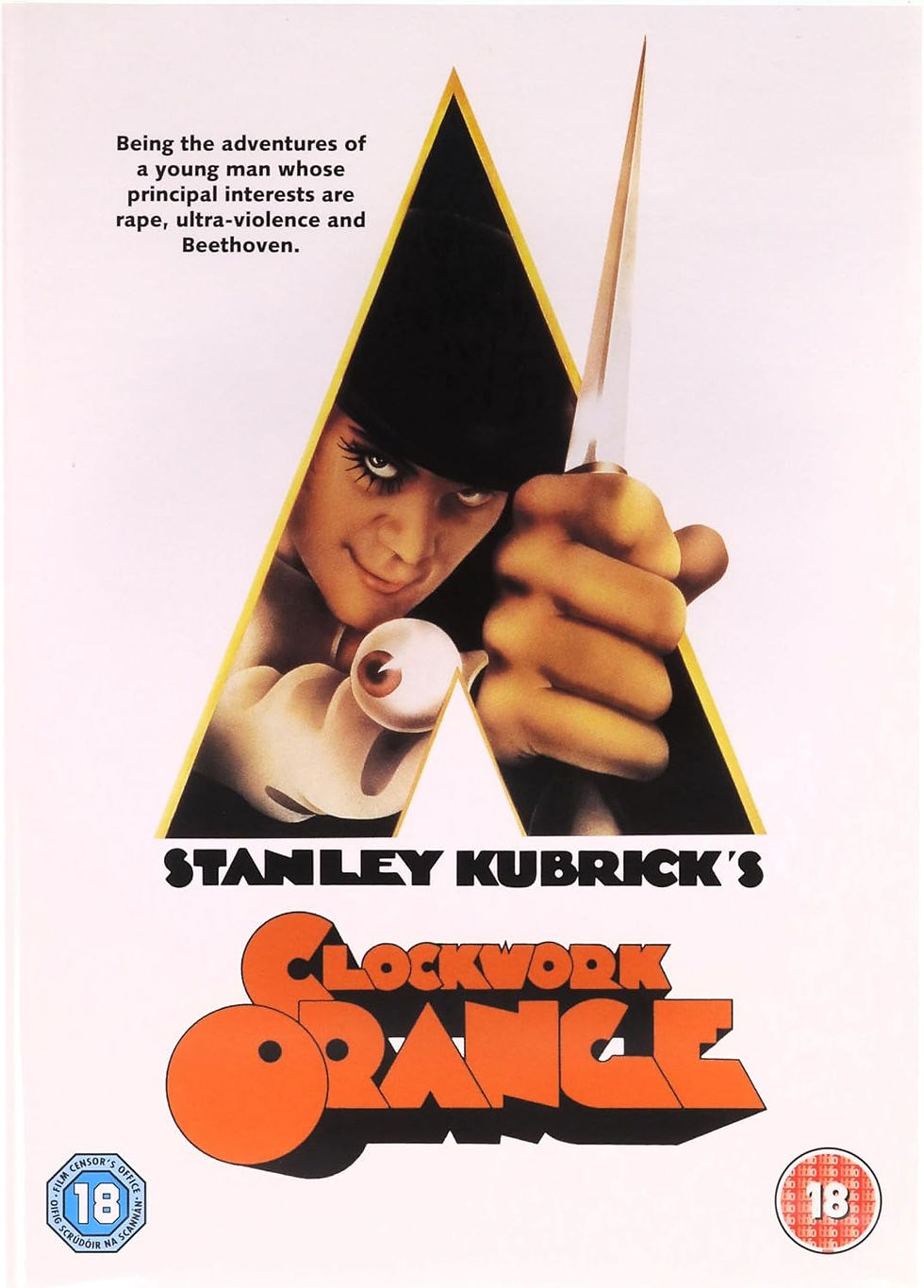
If Switched-On Bach demonstrated that electronic instruments could reconstruct the musical past, Carlos's work for Stanley Kubrick's A Clockwork Orange showed how effectively they could disturb it.

The film's world is filled with contradictions between classical culture and violence, refinement and brutality, human behavior and systems of control, making Carlos's electronic treatment of classical material particularly effective. Familiar musical structures acquire synthetic bodies, producing something recognizable but strangely displaced, as though European cultural history has been rebuilt inside a machine.
Carlos and producer Rachel Elkind became involved with Kubrick after the success of Switched-On Bach, beginning a relationship that Carlos later remembered as intellectually stimulating and technically engaged. The electronic soundtrack does more than establish futurism because its artificiality becomes psychological, surrounding a film obsessed with behavioral conditioning, authority, violence, discipline and the possibility of technologically reorganizing human behavior.
For an Atomique reading, this is where the aesthetic territory becomes particularly interesting. Not because A Clockwork Orange is “fetish music,” but because Kubrick and Carlos created a world in which uniforms, bodies, machines, control, classical discipline, artificial environments and stylized violence occupy the same visual and sonic system.
Those associations would become increasingly familiar across industrial music, electronic nightlife, fetish fashion and underground visual culture during the decades that followed.
Electronic Sound, Artificial Bodies
Electronic music introduced a profound cultural break because it separated sound from the requirement that listeners immediately understand its physical origin.
When a violin is heard, the listener can imagine the bow, string and wooden body producing it; when a drum is struck, impact remains embedded in the sound. A synthesizer can produce something whose physical source is far less obvious, creating tones that appear to belong neither to a recognizable object nor necessarily to the natural world.
This ambiguity became one of electronic music's greatest aesthetic resources.
Sound could feel metallic without metal, mechanical without machinery, vocal without a human voice or organic without an organism, creating an increasingly unstable territory between natural and artificial sensation. The same instability would later become important throughout underground visual culture, where latex could transform skin into reflective surface, leather could reorganize the silhouette of the body, masks could remove individual identity, prosthetics could alter anatomy and industrial spaces could turn architecture into theatrical machinery.
These cultures did not originate with Wendy Carlos, and there is no historical reason to claim a direct line of influence between them. What they share is a twentieth-century fascination with constructed sensation, in which technology and material intervene between the body and ordinary perception. Carlos helped make that possibility audible.
The Shining: Technology Without Futurism
Carlos later worked again with Kubrick on The Shining, although much of the music she and Rachel Elkind prepared was not ultimately used in the finished film. Carlos herself later noted that the project did not result in much of a film score, despite the extensive work surrounding it.
The association remains revealing because electronic sound no longer needed a futuristic environment to function. The Overlook Hotel is almost the opposite of technological science fiction: carpets, chandeliers, corridors, ballrooms, bathrooms, patterned walls and an architecture saturated with historical memory. Yet electronic music could enter this environment and make the building feel psychologically unstable.
This was another important stage in the cultural development of synthesis. The electronic sound no longer had to mean spaceship, computer or laboratory. It could signify atmosphere, memory, psychological tension, invisible threat and spatial disorientation.
Electronic music had escaped the machine while retaining its artificial power.

From Carlos to the Electronic Dance Floor
The distance between Switched-On Bach and a contemporary techno club may appear enormous, yet both belong to the historical process through which electronic instruments became accepted as complete systems for constructing musical experience.
The synthesizer moved from experimental studios into progressive rock, disco, ambient music, industrial music, synth-pop, house, techno, trance and countless other forms, while drum machines and sequencers extended the same logic from timbre into rhythm and repetition.
By the 1980s and 1990s, electronic music had developed an entire visual culture around technological production: machines illuminated in dark rooms, cables, racks, metallic surfaces, strobes, industrial architecture, repetition and anonymous bodies moving collectively through electronically generated sound.
Within some underground scenes, those environments overlapped physically and aesthetically with queer nightlife and fetish culture, particularly in cities where leather, industrial music, techno, BDSM and alternative fashion shared clubs, neighborhoods and audiences.
The relationship was never universal and should not be reduced to a single genealogy, but the aesthetic affinities are difficult to ignore. Electronic music could transform a room through frequency and repetition while fetish could transform the body through material, restriction, clothing and role. Both cultures became exceptionally sophisticated at constructing experiences through systems.
The Machine Was No Longer the Opposite of the Human
Perhaps the most important legacy of Wendy Carlos lies in the disappearance of a distinction that once seemed obvious.
Electronic sound had initially been imagined as artificial in opposition to supposedly natural musical expression, yet Carlos demonstrated that an electronically generated tone could carry articulation, precision, humor, tension, delicacy and emotional complexity without pretending to be an acoustic instrument.
Technology did not necessarily remove humanity from music because the machine remained dependent upon decisions made by the person operating it. This idea became foundational to electronic culture. A synthesizer does not eliminate expression; it relocates expression into another system of control. A sequencer does not eliminate rhythm; it allows rhythm to be constructed differently. A studio does not merely record an event; it can become the environment in which the event is created.
The distinction between natural and artificial consequently becomes less useful than the relationship between intention and design.
Wendy Carlos and the Architecture of Electronic Culture
Looking back from contemporary electronic culture, Carlos's influence extends far beyond the recognizable sound of the early Moog.
Switched-On Bach helped introduce synthesizers to a mass audience, and the Library of Congress credits the album with contributing to the instrument's rapid expansion across rock, dance and Western art music; Carlos's subsequent film work demonstrated that synthesis could operate psychologically and cinematically as well as musically, while her meticulous production methods anticipated a culture in which recording, programming, sound design and composition increasingly became inseparable.
For Atomique, her importance lies in this larger cultural transformation. The twentieth century increasingly became fascinated with surfaces that could be engineered, identities that could escape inherited categories, bodies that could be restyled, environments that could be programmed and machines that could produce experiences previously unavailable through traditional materials. Electronic music became one of the clearest expressions of that transformation, and Carlos stood at one of its decisive early moments.
Her work does not need an invented connection to fetish culture to belong within Atomique's wider archive of alternative aesthetics, because its relevance exists at a deeper level, within the history of technology, gender, cinema, control and the increasingly unstable boundary between the organic and the artificial.
Before the synthesizer became the engine of techno, before electronic sound filled queer clubs and industrial spaces, and before machines became inseparable from the aesthetics of contemporary nightlife, Wendy Carlos demonstrated that technology could do something much more interesting than imitate an instrument. It could construct an entirely new way of hearing.
Related Concepts
Electronic Music
Synthesizer History
Moog Synthesizer
Wendy Carlos
Robert Moog
A Clockwork Orange
The Shining
Electronic Sound
Sound Design
Industrial Music
Techno Culture
Queer Music History
Transgender Cultural History
Technology and the Body Artificiality
Underground Culture
Written by Otávio Santiago
Founder of Atomique Fetish, an editorial platform on fetish design
Cultural designer & researcher


