


Fetish in the 1940s: War, Pin-Ups, Bondage, and the Birth of the Fetish Underground
Updated: Aug 17
The 1940s occupy a decisive position in the history of modern fetish culture. The Second World War transformed everyday visual culture through uniforms, military discipline, industrial production, protective equipment, medical technology, and standardized clothing. Leather boots, gloves, belts, rubber equipment, gas masks, helmets, straps, and technical garments became familiar objects within a world increasingly organized around institutions and machinery.
At the same time, another visual culture was expanding through pin-ups, illustrated magazines, private photographs, mail-order catalogues, and specialist publishing. Bondage, corsetry, high heels, stockings, gloves, and restrictive clothing began appearing together with greater consistency, creating a recognizable aesthetic that would become increasingly sophisticated after the war.
The 1940s did not yet possess the public fetish communities of later decades. Instead, the period helped give the underground a visual language and, crucially, the means to circulate it.
War and the Standardized Body
Military mobilization placed millions of people inside systems of dress in which appearance immediately communicated rank, occupation, nationality, and authority. Uniforms demonstrated how clothing could transform the perception of a body through tailoring, insignia, boots, belts, gloves, and regulated presentation.
P

hotography: Envato Elements
These objects were not inherently fetishistic, but they carried associations that later fetish culture would repeatedly reinterpret. Leather suggested protection and physicality; uniforms communicated hierarchy and discipline; boots altered posture and silhouette; rubber and protective equipment introduced artificial surfaces that separated the body from its environment.
The gas mask became an especially striking example of this technological transformation. Designed for protection, it replaced recognizable facial features with lenses, filters, straps, and standardized industrial forms. Its later appearance within fetish culture would introduce entirely different associations with anonymity, enclosure, sensory transformation, and depersonalization.
Modern fetish culture would become exceptionally skilled at appropriating objects with existing cultural meanings and placing them inside new frameworks of fantasy, identity, and consensual roleplay. The wartime years created an enormous visual archive from which later generations could draw.
Pin-Up Culture and the Portable Erotic Image
Pin-up culture had existed before the war, but the 1940s gave it extraordinary visibility. Photographs and illustrations travelled through magazines, calendars, military barracks, lockers, correspondence, and personal collections, allowing idealized images of femininity to circulate across enormous distances.
Artists such as Alberto Vargas refined a visual language built around elongated legs, stockings, high heels, lingerie, controlled poses, and polished glamour. Although mainstream pin-up imagery was distinct from specialist fetish photography, the two worlds shared an important visual principle: desire could become concentrated around individual objects and details.

Alberto Vargas.
A stocking seam could direct attention along the leg, a heel could alter posture, and a glove could transform the appearance of the hand and arm. Clothing was no longer simply surrounding the body; particular garments could become central to how the body was imagined.
This concentration on objects would become one of the foundations of postwar fetish photography.
John Willie, Bizarre, and the Fetish Underground
The most important figure in the development of a coherent fetish visual culture during the decade was John Willie, the pseudonym of John Alexander Scott Coutts.
Willie's imagery brought bondage, corsets, stockings, gloves, high heels, restrictive clothing, and carefully staged power dynamics into a remarkably consistent visual universe. Rather than presenting these elements as unrelated interests, he combined them into an aesthetic system in which clothing, restraint, posture, character, and fantasy reinforced one another.
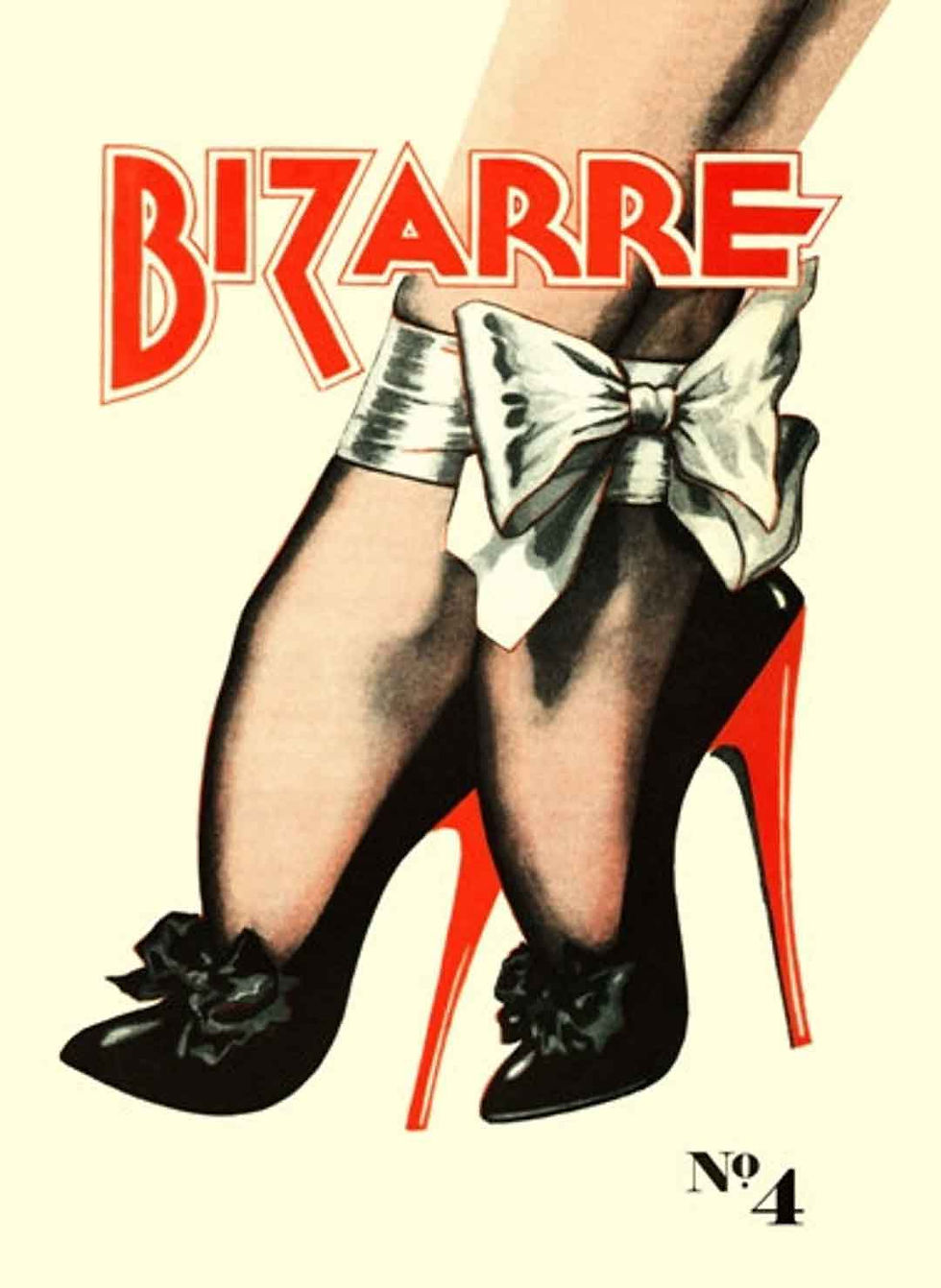
His magazine Bizarre, launched in 1946, became one of the foundational publications of modern fetish culture. Through illustration, photography, correspondence, fashion ideas, and fantasy, the magazine addressed readers who recognized themselves as sharing specialized interests.
John Willie.
This represented an important departure from the medical language that had dominated earlier discussions of fetishism. Instead of being described exclusively by doctors or sexologists, fetish interests could now be represented within publications created for the people who experienced them.
The underground was beginning to speak for itself.
Sweet Gwendoline and the Designed Fetish Body

Willie's famous Sweet Gwendoline stories demonstrated how effectively fetish could operate through narrative. Bondage was embedded within elaborate scenarios involving captivity, escape, theatrical danger, clothing, and role, allowing individual objects to acquire meaning through the fictional world surrounding them.
His illustrations also presented the body as something consciously engineered through fashion. Corsets reorganized the torso, high heels changed posture and balance, stockings altered the visual surface of the legs, while gloves and restraints extended the composition across the body.
This relationship between body and design became fundamental to modern fetish aesthetics. Rather than allowing clothing to disappear into a supposedly natural silhouette, fetish imagery frequently emphasized the mechanisms of transformation through lacing, straps, buckles, compression, seams, and visible tension.
The same principle would later appear through leather, rubber, latex, PVC, harnesses, masks, hoods, and increasingly specialized forms of fetish fashion.
Mail Order and the Invisible Fetish Network
Fetish culture also required infrastructure, and during the 1940s much of that infrastructure existed through the postal system.
Mainstream shops and publishers operated within strict legal and social restrictions surrounding erotic material, making mail-order catalogues, specialist advertisements, correspondence, and private distribution particularly important. Someone living far from a major city could encounter an advertisement, request material, and discover an
entire visual world that might otherwise have remained inaccessible.
Censorship influenced the imagery circulating through these networks. When explicit representation was restricted, objects and clothing became especially useful carriers of erotic meaning. Corsets, stockings, heels, uniforms, gloves, and restraints could communicate highly specific associations without requiring explicit sexual representation.
The resulting visual codes survived long after censorship began to change because they had become part of fetish culture's aesthetic language.
Tom of Finland and a New Masculine Image
While John Willie's world concentrated heavily on stylized femininity, Touko Laaksonen, later known as Tom of Finland, was beginning to develop another visual language during the 1940s.
His mature style would emerge more fully during subsequent decades, but its foundations were already connected to uniforms, boots, workers, motorcycles, physical strength, and exaggerated masculine bodies. Rather than adapting the established conventions of female pin-up culture, Tom gradually transformed masculinity itself into a highly constructed fantasy.

Tom of Finland.
This development coincided with a postwar visual culture in which leather jackets, motorcycles, heavy boots, workwear, and military references increasingly suggested mobility, machinery, physicality, and rebellion. These associations would later become important to gay motorcycle clubs and the emerging leather communities of the 1950s and 1960s.
The fetish body was therefore expanding in two directions: the highly constructed feminine body of bondage and restrictive fashion existed alongside an emerging hypermasculine vocabulary built around leather, uniforms, boots, and physical power.
From the 1940s to the 1950s
By the end of the decade, fetish culture possessed something it had previously lacked at comparable scale: a recognizable visual system connected to an emerging distribution network. Pin-up culture had demonstrated the power of reproducible erotic imagery, Bizarre had created a specialist editorial world around fetish interests, mail order allowed those interests to travel beyond local communities, and artists such as John Willie and Tom of Finland were developing visual archetypes that would influence generations.
The 1950s would expand this infrastructure dramatically. Bettie Page would become one of the most recognizable fetish models of the twentieth century, Irving and Paula Klaw would develop a remarkable photographic and mail-order archive, Physique Pictorial would provide an important platform for gay male imagery, and postwar motorcycle and leather networks would become increasingly connected to queer identity.
The importance of the 1940s therefore lies not in claiming that the decade invented modern fetishism. It created conditions in which previously scattered interests could begin to recognize one another through shared images, materials, objects, and publications. What had existed across fashion, private fantasy, erotic illustration, photography, military imagery, and sexological classification was gradually becoming a distinct cultural territory.
By 1950, the fetish underground had begun to acquire a recognizable shape.
Related Concepts
Related Concepts
Military Fetish
Stocking Fetish
Mannequin Fetish
Fetish Photography
Pin-Up Culture
Written by Otávio Santiago
Founder of Atomique Fetish, an editorial platform exploring fetish design, culture & visual research.
Visual research continues at @atomique.fetish ↗


